The vortex-shaped cloud-scroll pattern is a Chinese ornamental design built around rotational motion. Its core is a spiral, whorl, or pinwheel-like center, while hooked cloud scrolls curl around it or extend outward. The design became especially prominent during the Warring States period (475–221 BCE) and continued into Qin and Han visual culture.
It is best understood as a formal design language rather than a single image with one fixed meaning. Depending on the object and period, the pattern could evoke moving air, clouds, vitality, celestial space, continuity, or simply the controlled energy of curved lines.
| Chinese name | 涡形卷云纹 |
|---|---|
| Pinyin | Wō xíng juǎn yún wén |
| Recommended English name | Vortex-Shaped Cloud-Scroll Pattern |
| Main historical range | Most characteristic of the Warring States period; related spiral-cloud compositions continued into the Qin and Han dynasties. |
| Common media | Bronze vessels and fittings, lacquerware, architectural tile ends, ceramics, and other decorated objects. |
| How to recognize it | A rotating center combined with repeated hooked, comma-shaped, or inward-curling cloud units. |
| Core associations | Movement, circulating force, clouds, celestial rhythm, continuity, and dynamic balance. These associations vary by context and should not be treated as a universal ancient code. |
What Is a Vortex-Shaped Cloud-Scroll Pattern?
The name describes both the motif's structure and its movement. “Vortex-shaped” identifies the rotating center. “Cloud-scroll” identifies the curled extensions that resemble stylized clouds, vapor, hooks, or comma-like lobes. A complete design may be enclosed inside a circle, repeated as a band, distributed across a vessel, or combined with animal and geometric forms.
The pattern is not defined by one rigid outline. Some examples have a tightly wound central spiral. Others use several curved blades revolving around a boss or circular hub. Outer scrolls may be large and widely spaced or small and densely repeated. What unites them is a sense of organized rotation: the eye is drawn inward and then carried outward along curling lines.

Five practical recognition points
- A rotational center: look for a spiral, pinwheel, circular boss, or group of curved blades.
- Hooked terminals: the surrounding lines often end in inward curls rather than straight points.
- Radial rhythm: the units turn around a center or repeat in a circular sequence.
- Positive and negative space: solid lobes and open gaps work together to make the design appear to rotate.
- Controlled symmetry: the pattern may be balanced without being mechanically identical in every segment.
Historical Origin and Development
Spirals are much older than the Warring States period. Curving and coiled forms appear on prehistoric pottery and on Bronze Age ornaments. However, a simple spiral should not automatically be called a vortex-shaped cloud-scroll pattern. The more specific type discussed here combines rotational organization with recognizable cloud-scroll units and a deliberate decorative program.
During the Eastern Zhou era, especially the Warring States period, Chinese ornament became increasingly fluid and layered. Bronze inlay, lacquer painting, architectural decoration, and textile-related visual habits encouraged designers to divide surfaces into rhythmic fields. Tight curls, S-curves, hooked clouds, interlacing bodies, and rotating medallions appeared in increasingly complex combinations.
Gold-and-silver inlay was particularly suited to this visual language. Bright metal lines stood out against darker bronze, allowing a craftsman to create movement with narrow curves and compact spirals. On circular surfaces, rotation could organize the entire design; on vessel walls, scrolls could form bands or connect larger motifs.

In Qin and Han contexts, cloud imagery continued to develop in architectural tile ends, lacquer, painted surfaces, and funerary art. Some designs became more expansive and airborne, while others remained compact and medallion-like. Later cloud patterns often favored flowing bands, ruyi-shaped heads, or long trailing forms. The Warring States vortex-cloud type, by contrast, usually feels concentrated and centripetal.
How the Pattern Creates Movement
1. The center acts as a visual pivot
A central boss, ring, or spiral gives the composition a stable anchor. The surrounding curves appear to rotate around it. This balance between stillness and movement is one reason the motif works well on round objects such as tile ends, mirror backs, fittings, and vessel medallions.
2. Curves change speed
Tight curls appear faster and more concentrated; broad arcs seem slower and more expansive. Designers could combine both to prevent the pattern from becoming flat. A narrow spiral might gather visual energy, while a long curve releases it into the surrounding field.
3. Repetition creates continuity
When the same hook or lobe returns at regular intervals, the viewer anticipates the next turn. This repeated rhythm can make a static surface feel continuous. On a circular field, the beginning and end are difficult to locate, strengthening the impression of unbroken circulation.
4. Empty space is part of the design
The gaps between curls are not accidental. Negative space separates neighboring units, clarifies direction, and keeps dense ornament legible. In metal inlay, the dark bronze ground may function as an active color that shapes the bright inlaid lines.
Symbolism and Cultural Interpretation
Clouds in Chinese art can be associated with the sky, changing weather, movement between realms, auspicious atmosphere, and the presence of extraordinary beings. A rotating composition may further suggest circulation, transformation, or an ordered cosmos. These interpretations help explain why modern viewers often read the motif as energetic and auspicious.
The safest conclusion is that the motif possessed strong visual and cultural resonance. It transformed abstract curves into an image of circulating motion while remaining adaptable to different materials. Its power lies as much in composition as in symbolism.
How the Pattern Changes Across Objects and Materials
Material changes the pattern's visual character. A carved or molded tile-end needs relatively strong ridges. A bronze inlay can support narrower lines and sharper contrasts. Painted lacquer can connect many curves without the structural limits of carving. For this reason, two objects may share the same vortex-cloud logic while looking very different.
How It Differs from Related Chinese Motifs
| Motif | How to distinguish it |
|---|---|
| Simple spiral motif | Usually consists of one coil or repeated coils. It may lack the cloud-like hooks, radial hierarchy, or multi-part vortex structure. |
| General cloud pattern | A broad category that includes many forms. A cloud pattern may flow horizontally or appear as isolated cloud heads without a rotating center. |
| Cloud-head pattern | Recognized by a compact lobed “head,” often used as a terminal or repeated unit. It does not require a vortex composition. |
| Flowing-cloud pattern | Usually elongated and directional, with trailing bands that suggest clouds moving across the sky rather than circling a pivot. |
| Wave or water pattern | Uses crests, parallel currents, foam, or rising waves. Spirals can occur, but the overall grammar emphasizes water rather than cloud scrolls. |
Modern Application and Responsible Revival
Contemporary designers can adapt the motif to jewelry, textiles, ceramics, graphics, packaging, and architectural surfaces. The strongest adaptations preserve its underlying grammar: a clear pivot, controlled curves, deliberate repetition, and balanced empty space. Simply placing an unrelated spiral beside a cloud icon does not reproduce the historical design logic.
Responsible revival also means identifying reconstructions honestly. When the original object is unavailable or a reference image contains labels and watermarks, a newly drawn teaching illustration should be described as a reconstruction. It should not be presented as a museum photograph or used to invent an archaeological provenance.
Cloud-Scroll Forms in Contemporary Adornment
The following real store designs were selected because their curves, ruyi heads, jade drops, or tassels create a visual dialogue with historical cloud ornament. They are contemporary accessories, not replicas of Warring States objects and not objects that guarantee luck, wealth, or protection.

S925 Silver Ruyi Cloud Red Agate Ring
The compact ruyi outline turns a cloud-derived curve into a wearable focal point, offering a modern comparison with the curled terminals of ancient scroll ornament.
$36.99 USD
View the design
Cloud and Green Jade Drop Earrings
Open cloud curves frame green jade drops, pairing the lightness of a scroll with the visual weight of polished stone.
$36.99 USD
View the design
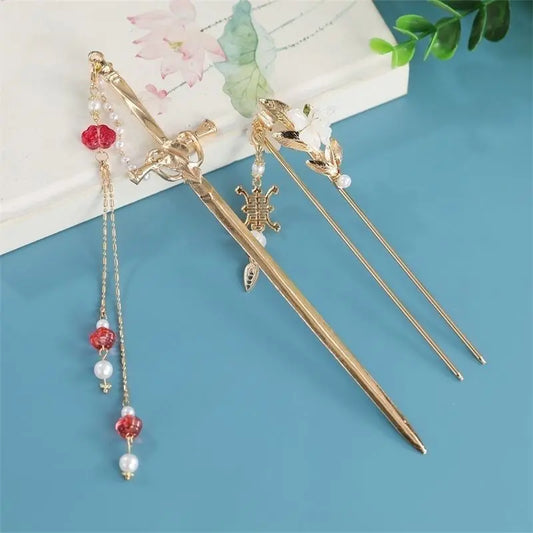
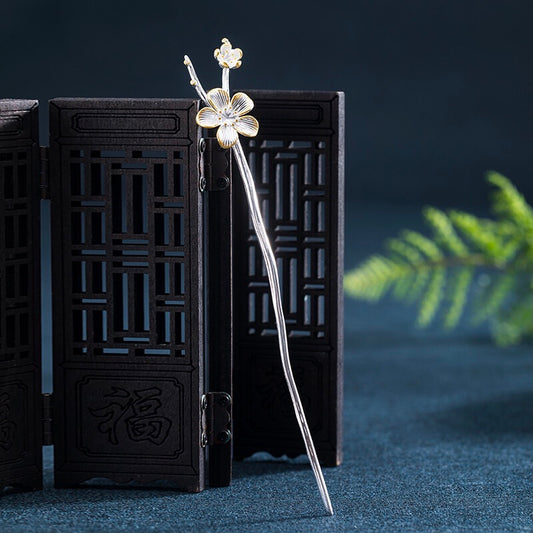
Ruyi Cloud Tassel Hairpin
The upright hairpin and moving tassel translate cloud-scroll rhythm into a hairstyle, where the ornament changes subtly with the wearer.
$24.99 USD
View the designFrequently Asked Questions
What is the vortex-shaped cloud-scroll pattern?
It is a Chinese ornamental composition that combines a rotating center with curled cloud-scroll units. It is especially associated with Warring States visual culture.
How can I recognize it?
Look for a central spiral, boss, or pinwheel surrounded by repeated hook-like, comma-shaped, or inward-curling forms that create radial movement.
Is it the same as a simple spiral?
No. A simple spiral can appear alone. The vortex-cloud type normally has a more organized center-and-scroll structure and a stronger relationship to stylized cloud ornament.
When was it most popular?
Its most characteristic development belongs to the Warring States period, although related spiral and cloud designs appeared earlier and continued into Qin and Han art.
What does it symbolize?
It can suggest clouds, circulating movement, vitality, celestial rhythm, continuity, or transformation. The exact meaning varies, and modern auspicious readings should not be treated as proven for every ancient object.
Are the two article images artifact photographs?
No. They are original, reference-based educational reconstructions made to remove text and watermarks. Their captions identify them clearly so they are not mistaken for museum photographs.
References
- Palace Museum. “Bronze Craftsmanship of the Spring and Autumn and Warring States Periods (continued).” Accessed August 13, 2026.
- Palace Museum. Collection and research materials on the Banquet, Fishing, Hunting, and Warfare Pictorial Hu. Accessed August 13, 2026.
- Tianshui Museum. Collection information for the Warring States silver-inlaid cloud-pattern bow support. Accessed August 13, 2026.
- Editorial Committee. Complete Collection of Chinese Bronzes. Beijing: Cultural Relics Publishing House.
- Tian Zibing. History of Chinese Arts and Crafts. Beijing: Eastern Publishing Center.
- Submitted reference images of a circular vortex-cloud tile-end composition and a Warring States gold-and-silver-inlaid bronze-vessel motif, consulted August 13, 2026. The article illustrations are newly created reconstructions.
Related Reading
- What Is the Chinese Cloud-Head Pattern?
- What Is the Chinese Spiral Motif?
- What Is the Chinese Water Pattern?