The Chinese honeysuckle pattern is one of those ornaments that can look familiar before its name is known. Its stems curve in a steady rhythm, leaves open like small wings, and flowers repeat along borders as if the plant could continue beyond the object. The motif appears on cave-temple murals, architectural tiles, stone carving, textiles, metalwork and ceramics. It is decorative, but it is also a record of how artistic forms travelled, changed and became local.
The English term "honeysuckle pattern" is useful but should not be read as a botanical diagram. Historical examples are highly stylized. Some resemble honeysuckle leaves; others are closer to palmettes, half-palmettes or composite floral scrolls inherited from Central and Western Asian ornament. Chinese craftsmen treated these forms as a flexible visual vocabulary rather than a literal picture of one species.
| Feature | Typical Character | Why It Matters |
|---|---|---|
| Chinese name | Rendong Wen | A conventional name for stylized scrolling foliage |
| Main period of popularity | Northern and Southern Dynasties, Sui and Tang | Closely connected with the expansion and localization of Buddhist art |
| Visual structure | Curling stem, split leaves, buds, palmettes and repeated units | Creates continuous borders and balanced compositions |
| Common media | Murals, tiles, stone, textiles, metalwork and ceramics | Shows the pattern's adaptability across materials |
| General symbolism | Endurance, renewal, continuity and auspicious vitality | Later interpretation draws on the plant's persistent growth |
What Is the Chinese Honeysuckle Pattern?
Rendong wen is a family of plant-based ornaments rather than one rigid design. The most recognizable version has an undulating stem with leaves or flowers growing alternately from each side. A single unit can also be isolated and arranged symmetrically, especially on roundels, roof tiles, halos, borders and small decorative fields.
Its design works because it balances repetition and variation. The vine supplies continuity, while changing leaves, petals and buds keep the line alive. Craftsmen could compress the motif into a narrow band, expand it over a wall, turn it around a circular object or combine it with lotus flowers and auspicious animals.

Where Did Rendong Wen Come From?
The pattern belongs to a much wider history of floral scroll ornament. Palmettes and scrolling foliage were used around the Mediterranean and in West and Central Asia long before they became common in Chinese Buddhist decoration. Trade, migration, diplomacy and the movement of religious images carried ornamental ideas across Eurasia. Along these routes, motifs rarely travelled unchanged: each region adjusted them to familiar materials, beliefs and tastes.
In China, imported-looking palmettes gradually merged with local cloud curves, lotus imagery and established preferences for rhythmic symmetry. The result was not a simple copy of a foreign ornament. It became a Chinese decorative system with its own proportions, combinations and meanings. This process is a good example of cultural localization: the motif retained clues to long-distance exchange while becoming fully integrated into Chinese art.
Why the Pattern Became Important in Buddhist Art
Buddhism provided a major setting for the spread of rendong decoration. From the fourth century onward, cave temples, sculpture, painted halos and architectural elements required rich borders that could frame sacred figures and organize large surfaces. A growing vine was ideal: it could be extended indefinitely and adapted to arches, niches, ceilings and garment edges.
At sites such as the Mogao Caves at Dunhuang, scrolling foliage appears beside lotus designs, geometric ceilings, celestial figures and narrative painting. Dunhuang Academy descriptions of Sui-period caves record honeysuckle and related plant ornament in ceiling and niche decoration. These compositions show how a once-transregional motif became part of a distinctly Chinese Buddhist visual world.

The pattern did not represent a single doctrine. Its religious suitability came from visual associations: unfolding life, continuous growth and ordered abundance. When paired with lotus flowers, it could support a Buddhist atmosphere of purity and spiritual flourishing. In other contexts, it functioned primarily as a prestigious and auspicious ornament.
Main Forms and Visual Features
Single and paired leaves
Early examples may use a compact leaf with one central lobe and two curling side lobes. Two leaves can face each other to form a balanced unit. These small motifs work well on the edges of halos, garment hems and narrow stone borders.
Three-lobed and fan-shaped palmettes
A common form opens outward like a fan or flame. The central blade rises vertically while the side lobes curve down and back. Repeated in a row, these shapes produce a pulse of expansion and contraction.
Continuous scrolling vines
In more elaborate designs, an S-shaped stem carries leaves, buds and flowers. Each turn generates the next, allowing the pattern to cover long borders. This continuous structure is one reason rendong wen is sometimes confused with the later, more naturalistic scrolling-flower pattern.
Composite floral designs
Chinese artisans freely combined honeysuckle leaves with lotus blossoms, rosettes, clouds, birds, dragons and geometric frames. These hybrids are often more historically accurate than a modern attempt to isolate one "pure" motif.

How the Pattern Changed Through Chinese History
Northern and Southern Dynasties
During this period, many rendong motifs retain a clear palmette structure. Leaves can look sharp, flame-like and strongly symmetrical. They often appear in Buddhist sculpture and cave-temple decoration, where they frame sacred images or occupy architectural borders.
Sui and Tang dynasties
Designs became fuller, more fluid and more integrated with lotus scrolls. Tang ornament favored generous curves and abundant floral forms. The distinction between honeysuckle, palmette and scrolling flowers therefore becomes less absolute. The motif's foreign ancestry was increasingly absorbed into a confident cosmopolitan Chinese style.
Song to Ming and Qing dynasties
Later decorative arts often preferred recognizable peonies, lotuses, chrysanthemums and seasonal flowers. Yet the underlying logic of the honeysuckle scroll survived: continuous vines, alternating leaves and symmetrical palmettes remained useful on textiles, ceramics, carved wood and metalwork. On blue-and-white porcelain, the pattern could be simplified into dark cobalt curls that frame a central emblem.

Meaning and Symbolism of Rendong Wen
The Chinese word rendong is associated with a plant that remains vigorous through difficult seasons, so modern explanations often emphasize endurance, resilience and long life. The endlessly returning vine also lends itself to ideas of continuity, renewal and unbroken good fortune.
These meanings are plausible cultural readings, but historical interpretation should remain careful. Not every ancient use was a coded message. Sometimes a border was selected because it was beautiful, adaptable and appropriate to a sacred or prestigious setting. Meaning arose from the combination of object, period, location and neighboring motifs.
When paired with a lotus, the design can suggest purity and spiritual flourishing. When arranged as an uninterrupted band, it may evoke continuity. When used on architecture, it contributes to protection, order and auspicious beauty. The motif's richness lies in this flexibility rather than in one fixed translation.
How to Identify a Honeysuckle Pattern
Start with the structure rather than the flower. Look for a rhythmic sequence of curling lobes attached to a stem or arranged around a center. The leaves often split into three parts and curl back at their tips. In early examples, the motif may look more like a flame or fan than a realistic plant.
Next, examine the context. A stylized palmette border in a Northern Dynasties Buddhist cave is more likely to be identified as rendong wen than a naturalistic peony vine on a Qing textile. Compare the object with dated museum examples and use several descriptive terms when searching.
| Pattern | Key Visual Clue | Common Confusion |
|---|---|---|
| Honeysuckle / Rendong | Palmette-like split leaves and curling lobes | Can resemble flames or abstract lotus petals |
| Lotus pattern | Layered petals centered on a blossom or seedpod | Often combined with rendong foliage |
| Scrolling flower pattern | Continuous vine carrying identifiable flowers | Later versions inherit the same scrolling logic |
| Cloud pattern | Rounded vapor curls without a botanical stem | Cloud curves can be woven into floral scrolls |
Rendong Wen in Modern Design
Contemporary designers can use the motif without reproducing an antique object exactly. A single palmette can become a pendant, logo or repeat unit. A scrolling border can be simplified for packaging, fabric, ceramics or interior trim. The most convincing adaptations preserve the motif's rhythm: outward-opening leaves, returning curves and a clear relationship between positive and negative space.
For culturally informed work, record the source period and object type. A Northern Wei cave border and a Ming porcelain scroll should not be treated as interchangeable. Good adaptation begins with close looking, then reduces or transforms the historical form for a new material.
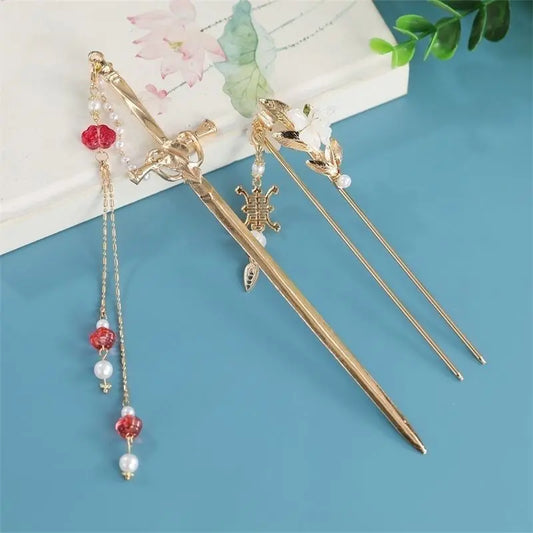
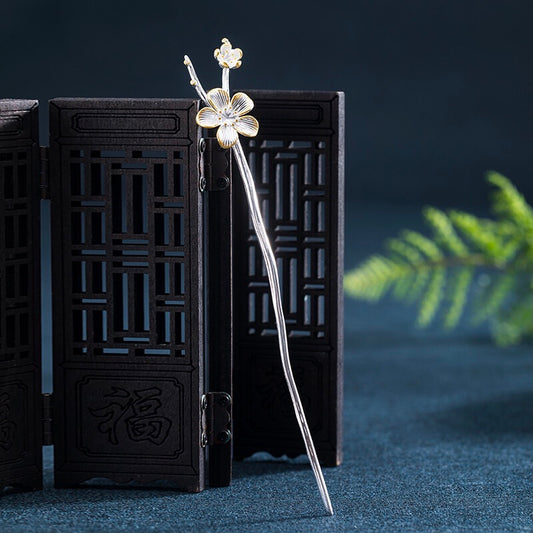
Selected Floral Jewelry
These pieces do not reproduce a single archaeological rendition of rendong wen. They extend the article's theme through floral forms, curling branches and traditional Chinese hair ornament.


Frequently Asked Questions
What does the Chinese honeysuckle pattern symbolize?
It is commonly associated with vitality, endurance, renewal and continuity. In Buddhist settings it can also contribute to a visual language of spiritual flourishing, especially when combined with lotus imagery.
Is Rendong Wen a Buddhist symbol?
It is not exclusively Buddhist, but Buddhist art was central to its early popularity in China. The motif decorated cave temples, halos, niches and architectural borders before spreading widely through secular decorative arts.
Did the honeysuckle pattern originate in China?
Its deeper ornamental ancestry is connected with palmette and foliage-scroll traditions from regions west of China. Chinese artisans localized those forms and developed distinctive rendong designs through centuries of adaptation.
How is a honeysuckle pattern different from a lotus pattern?
A lotus pattern usually emphasizes a central flower with layered petals. Rendong designs emphasize split, curling leaves or palmettes, often attached to a continuous vine. Historical objects frequently combine both.
Where can rendong patterns be seen?
They appear in Buddhist cave art, architectural tiles, stone carving, textiles, metalwork and ceramics. Dunhuang cave decoration and Northern Dynasties sculpture provide important early examples.
Is every scrolling vine a honeysuckle pattern?
No. Peony, lotus, grape and generic floral scrolls can use similar structures. Identification depends on leaf shape, historical period, material and the terminology used by the collecting institution.
Related Reading
Recommended Categories
References
- The Palace Museum: museum object description discussing rendong decoration
- Dunhuang Academy: Mogao Cave 314
- Dunhuang Academy: Mogao Cave 420
- Ministry of Culture and Tourism of China: research on the transmission of Mediterranean and West Asian ornament
- The Palace Museum Journal: research resource on historical decorative patterns
Historical motif names vary among institutions. This article uses "honeysuckle pattern" and "Rendong Wen" as practical umbrella terms while noting overlaps with palmette and floral-scroll ornament.