The Chinese Showcase journal Chinese symbols
Eight-Pointed Star Patterns in Chinese Brocade
Follow the eight-pointed star from three simple outlines to the diamond grids of Yao brocade, colorful Zhuang textiles, and early Chinese artifacts.
The eight-pointed star pattern (八角星纹, bājiǎoxīng wén) has eight tips extending from a center. A single star can resemble rays of light or an eight-petaled flower. In Yao and Zhuang brocade, the same basic form can sit inside a diamond, fill an octagonal frame, or repeat alongside other shapes across a length of cloth.
The three book illustrations reproduced here come from Huang Qingsui’s Illustrated Guide to Classic Chinese Patterns. The two textile designs are the book’s redrawings, with individual motifs and print colors extracted for study. The black-and-white example is labeled Yao brocade, and the multicolored example is labeled Zhuang brocade.
Three Forms of the Eight-Pointed Star

A Solid Star
Eight outward points alternate with inward notches. The center is filled, bringing the outline to the fore. The shape remains easy to recognize when reduced to a small repeat along a textile border.
A Star with a Square Center
The second drawing leaves a square opening inside the star. The outer points hold the silhouette together while the open square creates a second shape for the eye to follow. Changing which areas are dark and which are light shifts the emphasis without changing the lines.
A Star Made from Diamonds
The third drawing uses eight diamond-like pieces radiating from the center. Thin gaps keep the pieces distinct. The individual elements are easier to see here, and the star has the appearance of a flower with eight separate petals.
Eight-Pointed Stars in Yao Brocade
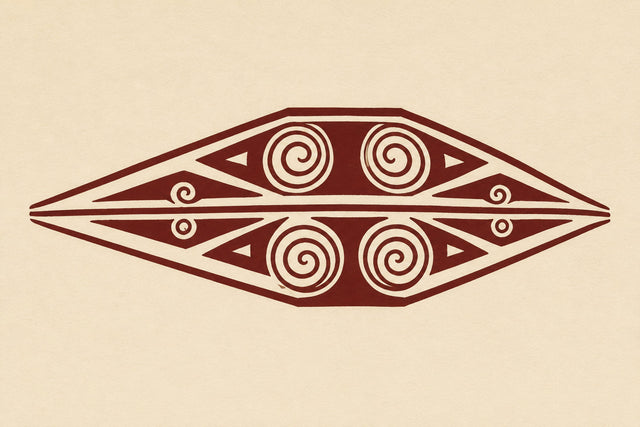
Start with the large diamonds in the black-and-white design. Each contains a set of smaller diamond compartments. Some have small stars formed by patches of light and dark. Others put a diamond in the center and surround it with finer lines. Several narrow borders divide the larger compartments and join into a grid.

Alternating dense and open sections gives the pattern a rhythm across the cloth. The printed black-and-white palette belongs to the book’s rendering. The date, fibers, and collection of the underlying textile remain unconfirmed. The Yao textile tradition includes other uses of the shape. An embroidered Guoshan Yao headcloth in the Guangdong Yao Museum places an eight-pointed flower motif around a spider in a web. Here the flower frames a single subject within a series of borders.
Eight-Pointed Stars in Zhuang Brocade
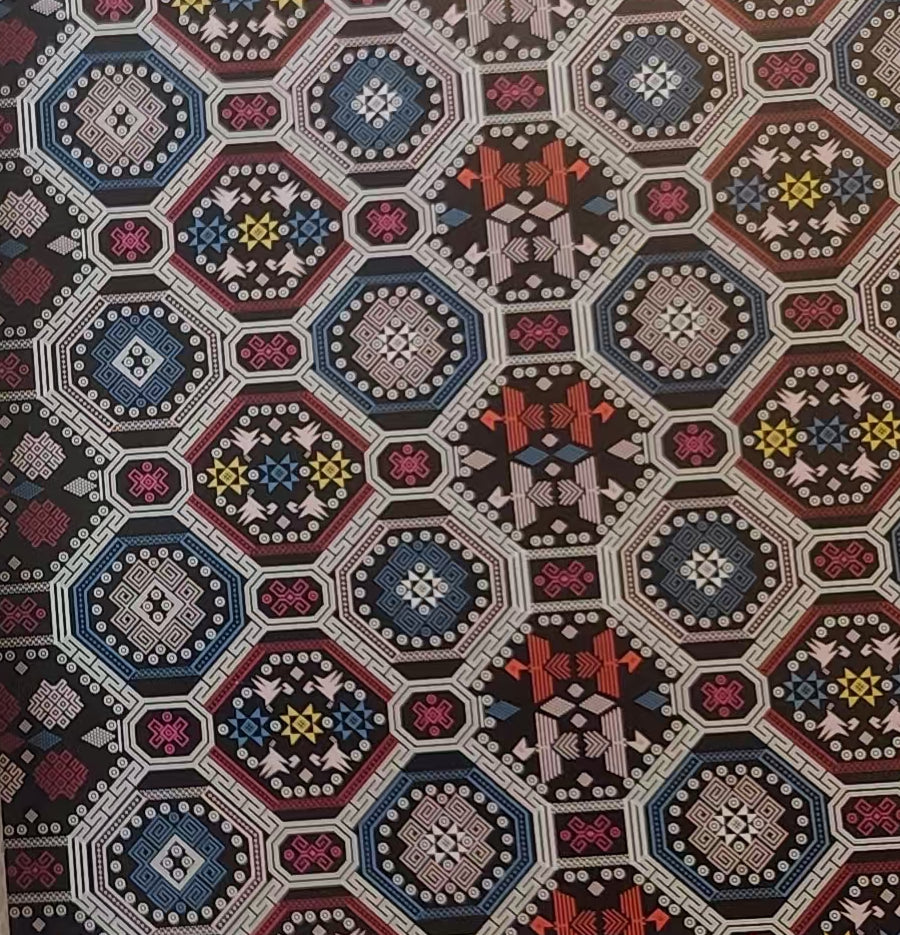
In the colorful drawing, connected octagons organize the surface. An octagon has eight edges. The star inside it is marked by eight projecting tips. Some blue-bordered panels place a pale star in the middle of stepped lines and tiny diamonds. Other panels put yellow and blue stars side by side, with pale birdlike shapes and dotted rings around them. Small red motifs occupy spaces between the larger frames.

A Zhuang brocade in the National Museum of Prehistory, Taiwan, provides a separate example. Its dark central strip contains octagonal and diamond shapes. The larger pink and red diamonds at the sides include lighter areas that form eight-pointed figures. Just as a star can be woven directly in bright thread, it can also appear where the colors around it leave a gap. Brocade of this kind has been used for clothing, bedcovers, and child carriers. The arrangement changes with the width and intended use of the cloth. Explore the broader craft in the guide to Zhuang brocade and living traditions.
Does the Eight-Pointed Star Represent the Sun?
Some archaeological examples have been interpreted as images of the sun. A painted Dawenkou culture pottery basin from the Dadunzi site, now in the Nanjing Museum, has seven eight-pointed figures around its exterior. The Liangzhu Museum’s exhibition notes describe both a solar reading and a reading in which the square center and radiating corners represent ideas about earth and sky.
A carved jade plaque excavated at Lingjiatan in Anhui also has an eight-pointed figure at its center. Archaeologist Zhang Jingguo discussed a solar interpretation for this specific Neolithic design in a Palace Museum lecture. See also sun patterns in prehistoric Chinese art.
Huang’s book also records proposed connections with lotus and chrysanthemum shapes. The diamond-based form looks especially petal-like because its segments remain distinct. The meaning of an individual star depends on its object, its surrounding designs, and the community that made or used it. The pictured brocades and the excavated pottery and jade offer evidence from different settings. A direct line of transmission between them remains unestablished.
How One Star Becomes a Repeating Pattern
Across woven threads, diagonal edges can be built a step at a time. The same star can be scaled down for a narrow band or placed in a larger unit containing diamonds, dots, and borders. Repeating that unit up and down and side to side creates a continuous field. Traditional Zhuang looms use a pattern mechanism known as a hualong, or pattern cage, that helps select threads for the design as the cloth is woven.
In the Yao drawing, the stars sit inside successive layers of diamond grids. In the Zhuang drawing, rows of octagons make room for solitary stars and groups of them. Look from a single star to the edge of its compartment. Where that edge meets the next is where a small motif becomes part of the larger design.
Who Might Enjoy Wearing an Eight-Pointed Star?
The eight-pointed star suits people who like symmetrical jewelry, geometric patterns, or traditional textiles. A small pendant or pair of studs makes the design easy to wear every day. A woven scarf or hair accessory gives the star room for the colors and borders that make brocade distinctive.
For a gift, think about what the recipient sees in the shape. The radiating points may suggest sunlight and suit someone celebrating a fresh start. A version with petal-shaped points appeals to someone who prefers floral designs.
Frequently Asked Questions
What is an eight-pointed star pattern?
It is a geometric design with eight tips radiating from a center. The center can be solid, open, or divided into eight separate elements.
How do I tell an eight-pointed star from an octagon?
Count the star’s eight projecting tips and the octagon’s eight sides. Zhuang brocade can show the two shapes together, with a star inside an octagonal frame.
Where does the star appear in the Yao and Zhuang examples?
The book’s Yao example places small stars within repeating diamond grids. Its Zhuang example places stars individually or in groups within larger octagonal frames.
Does the eight-pointed star always mean the sun?
The solar interpretation applies to some archaeological examples. Flowerlike forms and textile uses have their own contexts, which help establish what a particular object may mean.
What does a four-direction repeat mean in a textile?
A unit is repeated across both the width and the length of the cloth. An eight-pointed star can be one element within that unit, together with borders, dots, and diamonds.
Related Brocade and Geometric Designs
These contemporary accessories explore brocade, woven motifs, and radiating floral forms.
-

Zhuang Brocade-Style Gourd Bag Charm
An osmanthus-pattern charm with Zhuang brocade-inspired fabric and a cream tassel.
-

Dunhuang Baoxiang Flower Bracelet
Layered petals radiate from the center of a teal Baoxiang flower on braided cord.
-

Song Brocade Butterfly Hairpin
A double-sided brocade butterfly in pink and blue, finished with imitation pearl drops.
References and Further Reading
- Huang Qingsui, Illustrated Guide to Classic Chinese Patterns (中国经典纹样图鉴). Posts & Telecom Press, 2021, pp. 16–19. ISBN 9787115552006.
- Guangdong Yao Museum, Embroidered Guoshan Yao Headcloth, collection record.
- National Museum of Prehistory, Taiwan, Zhuang Brocade, accession 20050100072.
- China Intangible Cultural Heritage Digital Museum, Zhuang Brocade Weaving, national list entry VIII-20 and report on traditional looms.
- Liangzhu Museum, exhibition notes for the painted eight-pointed star basin from Dadunzi tomb M44, object 4, Nanjing Museum collection.
- Palace Museum, lecture summary for Zhang Jingguo, Lingjiatan Culture and the Dawn of Civilization in the Yangtze River Basin, on the carved jade plaque and solar imagery.
Stories, symbols and everyday objects
Our journal explores Chinese culture and design. Traditions and interpretations vary by region and source. For a purchase, use the specifications on the individual product page.
About Chinese ShowcaseQuestions or corrections? Contact us ↗