The Chinese Showcase journal Chinese symbols
Phoenix and Cloud Scroll Motif in Chu Lacquerware
Two facing phoenixes and a sweep of curling lines reveal how Chu lacquer painters gave birds the shape and movement of clouds.

The phoenix and cloud scroll motif pairs stylized Chinese phoenixes, or fenghuang, with curling lines that suggest clouds. In this design, two round-eyed birds face each other across a narrow gap. Sweeping curves open out from the birds and turn back at the bottom, giving the pair a nearly closed outline. The caption in the supplied reference traces the design to lacquerware excavated at Guodian in Jingmen, Hubei.
The Motif at a Glance
| Motif | Paired Chinese phoenixes with cloud scrolls |
|---|---|
| Identifying features | Facing heads, round eyes, long arcs, and curling ends |
| Reference origin | Guodian Chu tomb, Jingmen, Hubei, as identified by the supplied caption |
| Historical context | Warring States lacquerware in the Chu cultural tradition |
How to Recognize the Two Phoenixes
Start with the two small circles near the center. Each sits inside a dark shape and reads as the eye of a bird. A thin, round-tipped line rises above each head, and the pale space between the birds leaves both profiles visible. These few details carry much of the work of identifying the figures.
Follow the lines outward and their scale changes. The upper curves are broad. Toward the lower edges, the lines tighten into larger coils on either side and a pair of smaller curls close to the center. The drawing keeps recognizable bird features in a compact area so that the sweeping curves have room to extend around them.

How Symmetry Creates Movement
Both birds and the scrolls around them are arranged along a shared vertical axis. The heads draw the eye inward, while the long outer curves carry it down and around. At the bottom, the smaller turns direct attention back to the space between the two birds. The symmetry holds the composition together through these changes of direction.
The pale areas shape the design too. Thin strips of space separate the larger curves, and the gap between the heads opens out farther down. From a distance the outer contour can look heart-shaped. That effect comes from the two arcs closing toward a low point. Look closely and the paired eyes and scrolls become visible again.
The Guodian Chu Tomb and Its Lacquerware
Guodian is a village in what is now Shayang County, Jingmen, Hubei. Archaeologists excavated Guodian Tomb No. 1 in 1993. The excavation report places the burial in the later part of the middle Warring States period, based on the tomb and its contents. The burial is best known for its bamboo manuscripts. Lacquered wooden objects found with them are another record of the material culture of Chu. [1]
A lacquer ear cup documented from the Guodian Chu tomb gives an example of how curved motifs could be used on a vessel. Ear cups have two handles that extend out from the sides. On this cup, the broad upper faces of the handles carry symmetrical bird and animal motifs with cloud scrolls. Linked scrolls run along the narrower rim and outer sides of the handles, where a continuous line fits the available space. [2]
The supplied drawing gives us the composition and the location named on its label. Identifying the precise vessel, its original lacquer colors, and where the image sat on the object would require a match to an excavation plate or collection record.
Where the Phoenix and Cloud Scroll Meet
A cloud scroll is an ornamental curve that coils back at its tip. On a narrow rim, a series of coils can be joined into a band. Across a wider surface, the curves can spread out to fill the intervals between figures. The body and tail of a stylized bird can follow these same turns, while the head retains enough detail to identify it.
Research published by the Palace Museum describes this approach in Warring States Chu lacquerware. Some designs preserve only a head or a few other features. The body can extend into a band or take the form of spirals and clouds. In the Guodian reference drawing, the eye marks give viewers a place to start, and the lines around them let the bird figures and cloud scrolls read as a single design. [3]
The broader Chinese phoenix bird motif takes many other forms. It also helps to look at how a vortex-shaped cloud scroll is built from repeated curves.
From a Lacquer Ear Cup to a Circular Dish
The relationship between phoenixes and cloud scrolls is also visible in Western Han lacquerware. A painted round dish in the Palace Museum, excavated from Tomb No. 2 at Gaotai in Jiangling, Hubei, is decorated with phoenix forms built from connected spirals. Red dots and short curves punctuate the design. At each phoenix head, a smaller stylized bird painted in red marks the position of the larger figure. [4]
On the ear cup, the handle gives the painter a short field with its own edges. On the round dish, the scrolls can lead the eye around the vessel. The curved outlines in the Guodian reference draw the eye toward the center. Each arrangement shows how a few related forms can be fitted to the space a lacquer painter has to work with.
What Does the Paired Phoenix Motif Mean?
The facing pose gives the two birds a relationship that is easy to read. Each has its own shape, but both turn toward the same space. In a contemporary design, two phoenixes arranged this way can suggest harmony or companionship. Interpreting a particular Warring States object calls for a look at its use, the other motifs on it, and the objects found with it.
The drawing’s heart-like outline is one way a modern viewer might describe its shape. Its strongest historical detail is the handling of the bird itself. Round eyes and a small part of each head remain recognizable as the curves change scale and take on the shape of cloud scrolls.
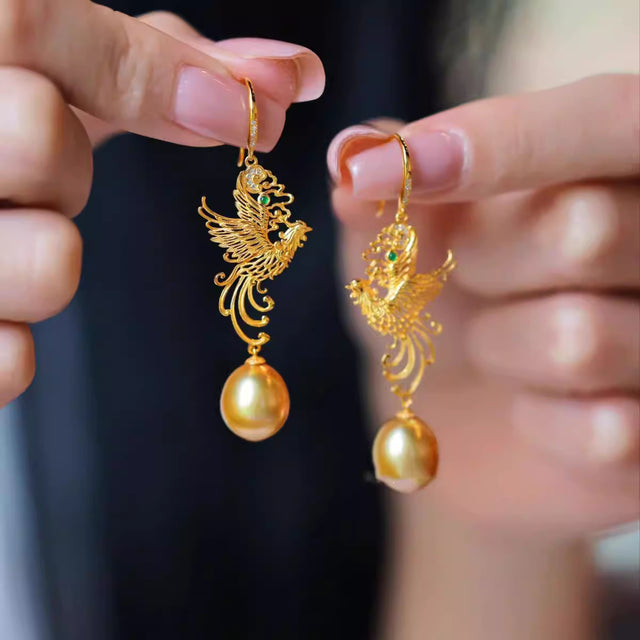
Phoenix-Inspired Jewelry


Frequently Asked Questions
What is the phoenix and cloud scroll motif?
It is a decorative design that combines stylized Chinese phoenixes with curling cloud forms. In Warring States Chu lacquerware, some birds can be recognized by their heads even when their bodies take the form of scrolls.
How can you identify the pattern?
Look for a recognizable bird feature, such as a round eye or the outline of a head. Then trace the nearby lines. In this Guodian reference, the two heads face across the center and the curves around them fold back into scrolls.
Where was this phoenix design found?
The reference caption attributes the design to lacquerware excavated from a Chu tomb at Guodian in Jingmen, Hubei. The photograph shows a drawing of the motif. The exact vessel would need to be identified from the original object record.
What do two facing phoenixes symbolize?
Facing phoenixes can express harmony or companionship in contemporary design. For a historical object, its function and accompanying decoration provide the context for interpreting the pair.
For more examples of where these forms appear, browse the Chinese Symbols and Their Meanings guide.
Sources
Stories, symbols and everyday objects
Our journal explores Chinese culture and design. Traditions and interpretations vary by region and source. For a purchase, use the specifications on the individual product page.
About Chinese ShowcaseQuestions or corrections? Contact us ↗