The Chinese Showcase journal Chinese symbols
Cloud-Head Scroll Pattern on a Chinese Bronze Belt Hook
A pointed outline and paired inward curls define the cloud-head scroll. Read the handbook illustration and follow its connections to bronze belt hooks, cloud scrolls and ruyi.
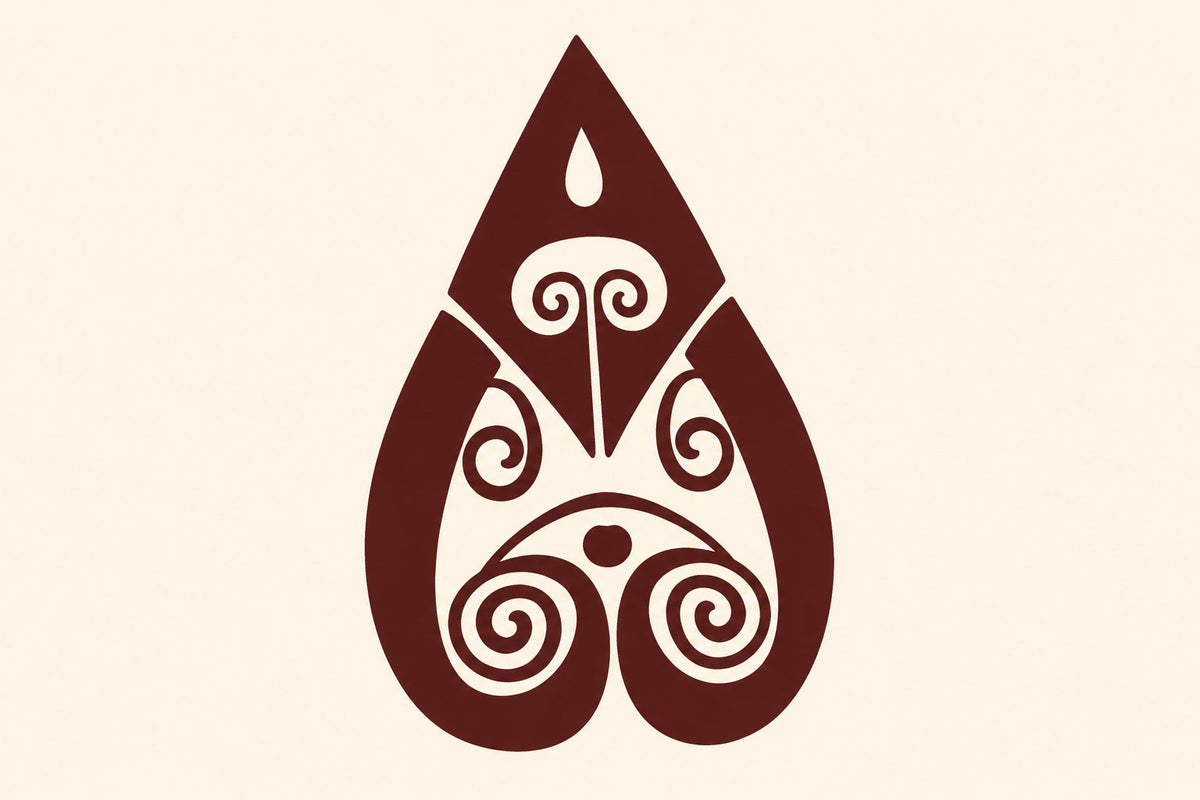
The cloud-head scroll pattern (云头卷云纹, yún tóu juǎn yún wén) is a Chinese decorative motif built around a tapered outline and curls that turn inward in pairs. In the handbook drawing shown here, the curls grow from a compact upper group into two broad spirals at the base. The narrow point and rounded lower lobes hold the whole design together.
Hongtang Meixue’s Pattern Design Quick Reference Handbook groups this drawing with Warring States patterns. Entry 0007 identifies its source object as a bronze belt hook with gold and silver inlay. The illustration shows the ornament in isolation. The original hook’s collection, findspot, dimensions and the position of the design on its surface remain unconfirmed. [1]

View the original photograph crop

How to Recognize the Cloud-Head Scroll
Start at the pointed tip. A small, light teardrop sits within the dark upper field. Below it, two small curls face inward near the top of a pointed central shape. A second pair of curls sits out at the shoulders. At the bottom, the widest lines sweep downward and wind into two large spirals, with a small dark dot above the space where they nearly meet. [1]
Follow the dark outline and then look at the light spaces. Thin channels separate the curls so their tips stay distinct even where the design is dense. The left and right halves broadly echo each other, while the pointed top and rounded base give the motif a clear direction. You can recognize the arrangement even if you lose sight of the smallest curls. [1]
The neighboring opposing cloud scroll in the handbook spreads left and right along a diagonal sweep. The cloud-head scroll gathers its lines down a vertical axis. The cloud-and-thunder pattern on the same page offers another point of comparison. Its repeating units turn at right angles, while the cloud-head scroll uses rounded coils. [1]

Why the Design Works on a Belt Hook
A Chinese belt hook, or dàigōu (带钩), fastened a belt or a garment. The curved end and a projecting stud on the reverse can be seen on surviving examples. On the exposed face, ornament could respond to the shape of the metalwork. A taper could carry a small curl and a broader area could hold a pair of larger ones. The handbook’s drawing makes that principle easy to see because its scale changes from end to end. [3]
A bronze belt hook in The Metropolitan Museum of Art, accession 2002.134, provides a documented material comparison. The museum dates it to the fourth to third century BCE and identifies gold and silver inlay in the bronze. The museum’s 20.3-centimeter example shows the scale at which metalworkers could arrange finely worked ornament on a functional fastening. The handbook’s drawing gives a close view of the ornament in entry 0007. [2]
What Gold and Silver Inlay Adds to the Design
In gold and silver inlay, metal is fitted into recesses in a base surface. The Palace Museum’s explanation of the technique describes laying wire or sheet into grooves and polishing the surface smooth. A maker could use a fine line to trace a curl and a broader area of metal to hold a rounded lobe. On a small object, differences in tone help these shapes remain legible. [4]
The handbook gives entry 0007 in two printed tones. Those tones let us examine the layout of the curls and the space between them. Matching either printed tone to gold, silver or exposed bronze would require a photograph or technical record of the original fastening. [1]
Cloud-Head Scrolls, Ruyi and Auspicious Clouds
The term cloud-head describes a compact cloud shape that can finish a line or organize a motif. The Palace Museum uses ruyi-style cloud-head for a related form whose lobes resemble the cap of a lingzhi fungus. A Qing zitan wood scepter with a cloud-shaped head and inset jade shows how a similar outline was used in a much later craft tradition. [5, 6]
That later comparison helps explain why cloud heads and ruyi ornament can look familiar beside one another. The cloud-head scroll in entry 0007 is recognizable by its pointed outline and its tiered curls. Auspicious cloud, or xiangyun, is a broader name for cloud imagery associated with good wishes. For this drawing, the clearest reading begins with the way the coils sit within the outline. Their inward turns produce movement while the paired arrangement gives the design a strong center. [1]
Frequently Asked Questions
What is a Chinese cloud-head scroll pattern?
It is a cloud motif composed of inward-turning curls grouped within a compact head or outline. The handbook’s example has a pointed tip, small curls at the shoulders and two broad spirals at the base.
What object is shown in handbook entry 0007?
The drawing records a motif from a bronze belt hook with gold and silver inlay. It appears in the Warring States section of the handbook. The drawing shows the pattern alone, and the hook’s collection and excavation history remain unconfirmed.
How do cloud-head scrolls differ from opposing cloud scrolls?
In these handbook examples, the cloud-head scroll is organized around a pointed vertical axis. The opposing cloud scroll spreads across a broad horizontal field with its principal curls facing from opposite ends.
Is a cloud-head scroll the same as a ruyi motif?
The forms overlap. A ruyi-style cloud head often has a lobed or lingzhi-like outline. The cloud-head scroll in this drawing is identified by its pointed shape and paired curling lines.
What are Chinese bronze belt hooks used for?
Belt hooks fastened a belt or garment. Surviving examples are often curved, with a hook at one end and a projecting stud on the reverse. Their exposed faces could carry inlay and other ornament.
Jewelry with Cloud and Scroll Motifs
These contemporary pieces use details such as curling lines, shaped cloud heads or openwork.


References
- Hongtang Meixue. Pattern Design Quick Reference Handbook (纹样设计速查手册). Posts & Telecom Press, 2024. ISBN 9787115643353. Cloud Patterns, Warring States section, illustration 0007.
- The Metropolitan Museum of Art, Belt Hook, Eastern Zhou dynasty, Warring States period, fourth to third century BCE. Accession 2002.134.
- National Museum of Asian Art, Smithsonian Institution, Garment Hook, F1915.229. Collection record and description of the reverse stud.
- The Palace Museum, Bronze Food Vessel with Gold-Inlaid Cloud Motifs (Cuojin Yunwen Dun), 故00077405. Collection record and glossary entry on inlay.
- The Palace Museum, Ruyi-Style Cloud-Head Pattern (Ruyishi Yuntouwen).
- The Palace Museum, Zitan Ruyi Scepter with Inset Jade and Cloud-Shaped Head (Zitan Qianyu Yuntoushi Ruyi), Qing dynasty. 故00122126.
Stories, symbols and everyday objects
Our journal explores Chinese culture and design. Traditions and interpretations vary by region and source. For a purchase, use the specifications on the individual product page.
About Chinese ShowcaseQuestions or corrections? Contact us ↗