The Chinese Showcase journal Chinese culture
What Is Yushui? China’s Rain Water Solar Term
Yushui, or Rain Water, marks a change in early spring moisture. See how its name connects the solar calendar to thawing ground and spring fieldwork.
Yushui (雨水, Yǔshuǐ), or Rain Water, is the second of China’s 24 solar terms. It starts when the Sun’s apparent ecliptic longitude reaches 330°, usually around February 18–20. Its name describes a seasonal shift toward spring rain in the landscapes where the calendar took shape.
What Does Rain Water Mean?
Yǔ means “rain,” and shuǐ means “water.” “Rain Water” preserves the two parts of the name. The Hong Kong Observatory uses “Spring Showers,” a translation that places the rain into its early spring setting. The same term follows the Beginning of Spring and comes before the Awakening of Insects.
Read the name with the Yellow River basin in mind. In its account of Yushui, the China Intangible Cultural Heritage Network describes communities accustomed to more snow in winter and an increase in rain as conditions warmed. The calendar gives that transition a memorable name. The season it describes can still include snow, freezing nights, and a return of colder air.
Why Yushui Falls in February
The date tracks an angle along the Sun’s apparent yearly path, the ecliptic. The change from the preceding solar term to Yushui spans 15° of solar longitude. An almanac can calculate the exact moment for a given year and time zone. In ordinary conversation, Yushui can mean the day of that moment or the interval that follows until Jingzhe.
Solar terms are used inside the traditional Chinese lunisolar calendar. Yushui stays in roughly the same part of the Gregorian year because its definition follows the Sun. Its date on the lunar-month calendar can shift as the lunar months move relative to the solar year.
Rain and Thaw at the Start of Spring
At the start of spring, a rain shower and a thaw can change a field at different speeds. A shower wets the surface first. In a cold district, the soil below may still be frozen, which limits how far water can soak in. Later, thawing soil and rising temperatures make early field preparation possible. A wet path and workable ground can therefore arrive on different days.
The farming association is easiest to see by comparing regions. The heritage network contrasts the Yellow River basin with the milder Sichuan basin, where winter rain is familiar before Yushui arrives. In the Yellow River basin, a shift from snow toward rain gives the name particular force. In the Sichuan basin, the season can feel more like the continuation of a familiar wet winter. The same date helps observers compare two different transitions.
How Traditional Observers Read the Season
Traditional descriptions split the term into three shorter periods and associate them with otters catching fish, geese moving north, and grasses or trees beginning to sprout. These observations bring water, animal movement, and new growth into one account of the season. They make sense as a collection of seasonal signs, with the timing of each sign depending on where it is observed.
Two water-themed solar terms give spring a useful frame. Rain Water comes near the start, when the change in precipitation draws attention. Grain Rain comes at the end, when soil moisture and the growth of grain are the focus. Their names connect the same element with two different moments in the agricultural year.
Frequently Asked Questions
When is the Rain Water solar term?
Yushui usually begins around February 18–20. The exact date and local time vary by year because the term begins at 330° of solar longitude.
Is Yushui the same as Grain Rain?
Yushui is the second solar term and starts in February. Grain Rain, or Guyu, is the sixth and begins around April 20 at the end of traditional spring.
Does Yushui mean it will rain on that day?
Rain Water names a seasonal tendency. Whether rain or snow falls in a particular place depends on local weather.
Why is Yushui sometimes translated as Spring Showers?
Spring Showers describes the early spring shift toward rain. Rain Water is a more literal rendering of the two Chinese characters.
Continue Through the Solar Terms
- Previous term: Beginning of Spring (Lìchūn)
- Next term: Awakening of Insects (Jīngzhé)
- All 24 Chinese solar terms by season
References
- Hong Kong Observatory. The 24 Solar Terms.
- China Intangible Cultural Heritage Network. When the East Wind Thaws the Ground and Brings Rain, the Yushui Solar Term (东风解冻散为雨——二十四节气之雨水), 2018.
- China Weather Network. Origins of the Rain Water Solar Term (雨水节气的由来), 2009.
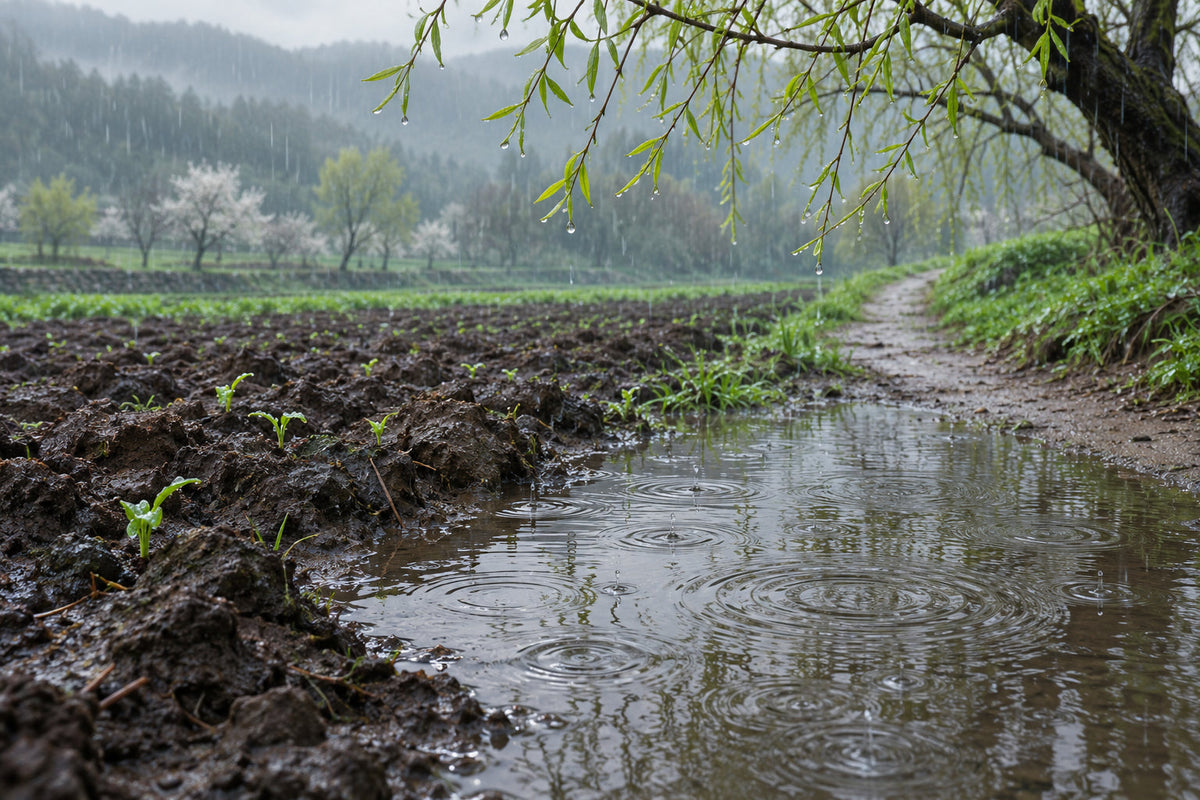
Rain ripples beside a willow and wet fields in early spring. AI-generated cover illustration.
The 24 Solar Terms
Choose a solar term below or browse the full seasonal guide.
| Season | Solar term guides |
|---|---|
| Spring | |
| Summer | |
| Autumn | |
| Winter |
Stories, symbols and everyday objects
Our journal explores Chinese culture and design. Traditions and interpretations vary by region and source. For a purchase, use the specifications on the individual product page.
About Chinese ShowcaseQuestions or corrections? Contact us ↗