The Chinese coiled chi-dragon pattern, commonly called pan chi wen or panchiwen, is one of the most fluid animal ornaments in early Chinese art. Its body bends, turns, and folds back into a compact unit, allowing a mythical creature to become both an image and a repeating design. On bronze vessels it may fill a narrow band; on mirrors it may circle a central knob; on jade it may become an openwork pendant whose tail completes the composition.
The pattern is often grouped loosely with “dragon motifs,” but that broad label hides important details. A chi is generally understood in art-historical writing as a dragon-like creature, frequently represented without prominent horns. Pan means to coil, curl, or wind around. Wen means pattern or ornament. The name therefore describes what the viewer sees: a chi-dragon compressed into a coiling arrangement.
| Question | Concise answer | Identification clue |
|---|---|---|
| What is it? | A coiled chi-dragon used as ornament | Curved animal body folded into a compact unit |
| Chinese name | 蟠螭纹, romanized as pan chi wen | Pan = coil; chi = dragon-like being; wen = pattern |
| Major periods | Especially Eastern Zhou and Han, with later revivals | Style and workmanship vary by date |
| Common media | Bronze, jade, mirrors, fittings, and later decorative arts | Cast relief, incision, openwork, or carving |
| Related motifs | Panlong, panhui, kui-dragon, and other dragon patterns | Compare horns, limbs, body form, and composition |
| Possible meanings | Energy, authority, protection, transformation, continuity | Meanings are contextual, not fixed guarantees |
What Is the Chinese Coiled Chi-Dragon Pattern?
Pan Chi Wen is a zoomorphic ornament: its lines ultimately represent an animal, even when the finished design looks almost geometric. The dragon's head, eye, snout, limbs, claws, and tail may all be present, but they are reorganized to fit a circle, arc, rectangle, or continuous border. The creature does not simply lie inside the available space. Its body actively defines that space.
This ability to move between figure and pattern is central to the motif. In a clear example, a viewer can trace a single head into a curved neck, torso, legs, and returning tail. In denser examples, several bodies touch, overlap, or mirror one another until the boundaries become difficult to separate. The resulting surface appears animated without relying on a narrative scene.
 Two compact arrangements show how animal heads, curled bodies, eyes, and hooked appendages can become a continuous ornament.
The English forms “coiled chi-dragon pattern,” “coiled chi pattern,” and “interlaced chi-dragon design” are all useful. “Hornless dragon pattern” is sometimes used as a shortcut, but it should not be treated as an absolute visual test. Ancient animal ornament varies, restoration can obscure details, and catalogue terminology is not perfectly uniform.
The Visual Grammar of Pan Chi Wen
A compact, turning body
The defining action is the coil. A chi-dragon may form a C, S, or nearly circular curve. The tail often turns inward, hooks back toward the head, or closes an empty area. On a long band, the body may stretch horizontally and then double back. The line feels tense and controlled rather than loose.
A recognizable head within abstraction
Look for an eye, rounded or angular snout, open jaw, crest, ear, or small horn-like projection. Early designs can be highly stylized, so the head may resemble a cluster of hooks and spirals. The eye is often the easiest anchor. Once it is located, the adjoining curves can be read as jaw, neck, and body.
Limbs that become hooks and scrolls
Legs and claws are commonly abbreviated. Instead of naturalistic anatomy, they may appear as short branches, hooked strokes, or comma-shaped curls. These appendages fill awkward gaps and lock neighboring units together. Their decorative role is as important as their zoological one.
Positive and negative space
Good Pan Chi Wen depends on the empty spaces between bodies. Round voids, narrow channels, and enclosed pockets keep a dense design readable. In openwork jade, those spaces are physically cut away; on bronze, relief and recessed lines produce a similar rhythm of solid and void.
When Did the Coiled Chi-Dragon Pattern Develop?
Dragon-like imagery has a much longer history than the mature Pan Chi Wen design. The specific coiled and interlaced vocabulary became especially visible during the Eastern Zhou period, when regional workshops transformed inherited bronze ornament into increasingly dynamic surfaces. Spring and Autumn examples often preserve strong animal units; Warring States compositions can become more intricate, repetitive, and structurally integrated.
This development was not a simple straight line. Different states, workshops, objects, and materials favored different solutions. One bronze band may contain small mirrored creatures, while another object enlarges a few chi-dragons into an openwork handle. A jade workshop could translate similar curves into thin, polished silhouettes. Dating therefore requires more than recognizing a coil.
 Warring States-style reconstructions demonstrate several solutions: arched chains, dense interlocking bands, angular repeats, and compact linked units.
During the Han dynasty, chi-dragon forms remained important on jade, mirrors, architectural ornament, and elite objects. Some examples become more sinuous and sculptural, especially when carved in relief or openwork. Later dynasties repeatedly returned to ancient bronze and jade vocabularies. Ming and Qing artisans could treat the chi-dragon as an antiquarian reference, adapting it to vessels, jade carvings, furniture, and scholar's objects.
A later object with Pan Chi Wen is not necessarily a forgery or a survival unchanged from antiquity. It may be a deliberate revival. Period attribution depends on material, tool marks, patina, carving technique, inscriptions, provenance, and comparison with securely dated objects.
Pan Chi Wen on Bronze Vessels and Mirrors
Bronze offered several ways to build the motif. Cast relief could raise the animal above the ground; thin incised lines could add internal detail; openwork could turn linked dragons into a structural handle. On ritual vessels and bells, Pan Chi Wen often occupies a clearly bounded zone. Repeated units conform to the edge while producing continuous motion across the surface.
A Palace Museum bronze bell described with coiled chi decoration shows how the motif could become three-dimensional and structural rather than merely printed onto a surface. Its linked creatures create an openwork effect, while other areas carry related small-dragon ornament. Such objects remind us that ancient “patterns” were designed together with casting technology.
Mirrors favor circular organization. Chi-dragons can revolve around the central knob, face one another, or divide the field into balanced sectors. The National Museum of China records a bronze mirror with three coiled chi motifs in shallow relief. Its controlled curves and strict arrangement show that movement and symmetry could coexist.
Why the Pattern Suited Jade Carving
Jade gives Pan Chi Wen a different character. Polished surfaces emphasize the uninterrupted sweep of a body, while relief carving makes the head and limbs emerge gently from the stone. Openwork allows the tail, neck, and legs to create actual holes, turning negative space into part of the object's structure.
A Han white-jade pendant discussed by the Wuxi Museum presents a single coiled chi whose curled tail helps form a ring-like outline. The combination of openwork and rounded carving makes the animal readable from several angles. Jade sword fittings also carried chi-dragon ornament, joining decoration with objects associated with rank and elite display.
Material matters when interpreting meaning. Jade itself carried associations with refinement, moral value, durability, and status in many historical settings. A chi-dragon on jade may therefore participate in a different social language from a small creature repeated on a bronze border, even when their curves resemble one another.
What Does Pan Chi Wen Symbolize?
The safest answer is contextual. The chi-dragon belongs to the broader family of powerful mythical animals in Chinese visual culture. Modern readers commonly associate it with vitality, protection, authority, adaptability, and auspicious energy. The coiling body can also suggest continuity because the eye follows a route that turns back into the composition.
Yet ancient ornament was not a dictionary in which every motif had one permanent translation. On ritual bronze, the pattern may have contributed to ceremonial presence and visual order. On a sword fitting, it could reinforce status and martial refinement. On a pendant, the creature's compact form might combine display, technical virtuosity, and protective association. The object's owner, function, date, and excavated context all affect interpretation.
For modern gifts and jewelry, the pattern can reasonably express resilience, inner strength, protection, or the ability to adapt while retaining one's center. These are contemporary readings grounded in the design's movement. They should be presented as intended messages, not as promises that an ornament can guarantee luck or change events.
Pan Chi Wen Compared with Similar Chinese Patterns
| Motif | Typical appearance | Difference from Pan Chi Wen |
|---|---|---|
| Pan Chi Wen | One or more compact, coiled chi-dragons | Coiling chi form is the central structure |
| Pan Hui Wen | Dense repeats of small snake-like or young-dragon units | Usually smaller, more numerous, and less individually legible |
| Panlong Wen | A coiled or circular full dragon | May show more explicit dragon anatomy and a different catalogue tradition |
| Kui-dragon pattern | Profile creature, often with a strongly angular body | Commonly reads as a side-facing unit rather than a compact interlace |
| Taotie mask | Frontal, symmetrical animal face | Organized around a central axis rather than a coiling body |
The distinction between chi and hui is especially important. In general explanations, chi is treated as a dragon-like creature, whereas hui can denote a small snake-like dragon. Pan Hui Wen frequently forms dense, repeated fields. Pan Chi Wen more often lets viewers follow larger individual bodies. Real objects can blur this neat division, so museum catalogue entries should take priority over visual guesswork.
How to Identify an Authentic Coiled Chi-Dragon Design
Begin with structure rather than symbolism. Find a probable eye and head, then trace the body. Ask whether the curve forms a coherent animal or only an abstract scroll. Look for abbreviated limbs and a returning tail. Next, study repetition: are units mirrored, rotated, interlocked, or arranged around a center?

Then examine the medium. Cast bronze lines behave differently from engraved lines, and openwork jade needs enough material to remain strong. Ornament that ignores the practical limits of its medium may be a modern redrawing rather than a faithful reconstruction. Finally, compare the design with documented museum objects from the proposed period.
Do not date an object from the motif alone. Revival styles, modern reproductions, and newly designed jewelry can all use convincing Pan Chi Wen. Reliable attribution requires provenance, technical examination, and specialist comparison. For a blog or product description, phrases such as “inspired by Warring States coiled chi-dragon ornament” are more accurate than claiming that a modern piece is itself ancient.
Using Pan Chi Wen in Contemporary Design
The motif adapts naturally to pendants, bracelets, rings, textile borders, packaging, and interior screens. A successful modern design preserves the coiling action and readable animal cues. Simplification should remove minor details before it removes the eye, head-body relationship, or returning tail.
For small jewelry, one chi-dragon can form an open circle around a stone or clasp. A bracelet may repeat linked bodies as a band. On printed material, a single large motif generally reads better than an extremely dense historical repeat. Designers should leave enough negative space for the pattern to breathe and avoid mixing too many unrelated auspicious symbols.
Cultural labeling also matters. Use “Chinese coiled chi-dragon pattern” and “Pan Chi Wen” in the product title or supporting text, explain the historical inspiration briefly, and distinguish a modern interpretation from an archaeological reproduction. This gives international readers useful context without turning a complex tradition into a vague “oriental” decoration.
Recommended Dragon-Inspired Pieces

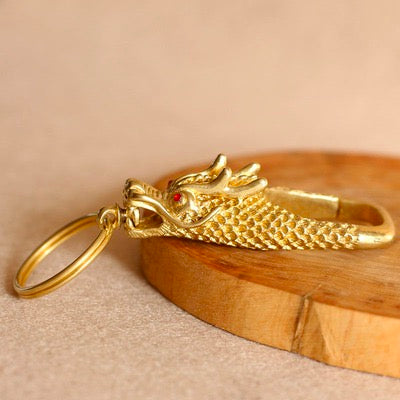
Golden Dragon Brass Keychain
A sculptural everyday piece that makes the dragon's curved body and animated head easy to see.
View Product
Dragon Emerald Chain Bracelet
The articulated chain and dragon head translate mythical-animal imagery into substantial silver jewelry.
View Product
Dragon and Phoenix Open Bracelet
A sculptural silver bracelet whose curving animal forms create a balanced open composition.
View ProductFrequently Asked Questions
What is Pan Chi Wen?
Pan Chi Wen is a Chinese decorative motif formed from one or more coiled chi-dragons. It appears especially on Eastern Zhou and Han bronze, jade, mirrors, and fittings.
What does the Chinese coiled chi-dragon pattern mean?
It may communicate vitality, authority, protection, adaptation, or continuity. However, meanings vary with the object's period, material, use, and archaeological context.
Is a chi the same as a Chinese dragon?
A chi belongs to the wider family of dragon-like mythical creatures, but art-historical descriptions often distinguish it by its compact, sinuous form and frequently understated or absent horns.
When was Pan Chi Wen popular?
It was especially prominent during the Eastern Zhou period, including the Spring and Autumn and Warring States eras, and continued through the Han dynasty. Later artisans also revived it.
What is the difference between Pan Chi Wen and Pan Hui Wen?
Pan Chi Wen generally emphasizes larger, traceable chi-dragon bodies. Pan Hui Wen often uses many smaller snake-like or young-dragon units to create a dense repeated field.
Where can coiled chi-dragon patterns be found?
They can be found on bronze ritual objects, bells, mirrors, jade pendants, sword fittings, and later decorative arts such as carved vessels, furniture, and jewelry.
Does Pan Chi Wen bring good luck?
It is often used today as an auspicious dragon-inspired design, but it should not be described as a guaranteed source of luck. Its strongest value is cultural, artistic, and symbolic.
How can I identify Pan Chi Wen?
Locate the eye and head, trace the body into a compact coil, look for hook-like limbs and a returning tail, and compare the result with documented museum examples.
Conclusion
Pan Chi Wen turns a mythical animal into a disciplined system of curves. Its head remains just visible enough to preserve identity, while its body folds into borders, circles, handles, and openwork forms. That balance between creature and geometry explains why the pattern could move so effectively among bronze casting, mirror design, jade carving, and later decorative arts.
Understanding the motif requires more than attaching a single auspicious definition. Look at structure, date, material, technology, and object function. When those elements are considered together, the Chinese coiled chi-dragon pattern becomes not merely an attractive dragon design but evidence of how Chinese artisans transformed movement, mythology, and craftsmanship into ornament.
References
- Bronze Bell with Coiled Chi-Dragon Pattern, Palace Museum.
- Bronze Mirror with Coiled Chi-Dragon Pattern, National Museum of China.
- Jade Sword Slide with Chi-Dragon Decoration, National Museum of China.
- Han White-Jade Coiled Chi Pendant, Wuxi Municipal Government and Wuxi Museum.
- Reading Animal Ornament on Ancient Chinese Bronzes, Hubei Provincial Department of Culture and Tourism.
Recommended Categories