Historical, Cultural & Practical Reasons
1. The Origins: From Cooking Tongs to Eating Utensils
Chopsticks (筷子, kuàizi) have been used in China for over 3,000 years. The earliest evidence comes from the Shang Dynasty (c. 1600–1046 BCE), where bronze chopsticks were discovered in tombs. However, these early chopsticks were likely used for cooking — to stir pots or retrieve food from boiling water — rather than for eating. The shift to eating occurred during the Han Dynasty (206 BCE – 220 CE), as population growth and resource scarcity encouraged more efficient food preparation. By the Ming Dynasty (1368–1644 CE), chopsticks had become the universal eating utensil across China. The Chinese word for chopsticks, kuàizi, originally combined the character for “quick” (快) with the “bamboo” radical (⺮), reflecting their material and convenience. Unlike knives and forks, chopsticks required no sharpening, did not conduct heat, and were cheap to replace.
2. The Eight Key Reasons (Complete Table)
The following table summarizes the primary reasons for the adoption and persistence of chopsticks in Chinese culture.
| Reason | Explanation | Evidence / Historical Context |
|---|---|---|
| 1. Ancient Cooking Origin | Chopsticks began as long tongs for stirring pots and serving food, not as eating utensils. | Bronze chopsticks from Shang Dynasty tombs (c. 1200 BCE); used to retrieve food from boiling cauldrons. |
| 2. Confucian Pacifism | Confucius (551–479 BCE) argued that a gentleman’s table should have no knives, as knives symbolize violence and warfare. Chopsticks represent civil, peaceful dining. | Liji (Book of Rites) records Confucius‘s preference for chopsticks and spoons over knives. |
| 3. Bite‑Sized Food | Chinese cuisine traditionally cuts meat and vegetables into small pieces to cook quickly and evenly. No need for a knife at the table. | Stir‑frying, steaming, and braising all require small, uniform pieces. This tradition dates to the Zhou Dynasty (1046–256 BCE). |
| 4. Fuel Scarcity | Smaller food pieces cook faster, saving scarce firewood (China historically deforested). Chopsticks are ideal for handling small pieces. | Already mentioned in Han Dynasty agricultural texts; fuel efficiency was a major factor in shaping Chinese cuisine. |
| 5. Communal Dining | In Chinese meals, dishes are shared. Chopsticks allow each diner to pick from communal plates without touching food with fingers. | Recorded as early as Tang Dynasty (618–907 CE); chopsticks also reduce germ transmission compared to shared spoons. |
| 6. Bamboo Availability | Southern China had abundant bamboo — cheap, lightweight, splinter‑free, and fast‑growing. Ideal for disposable chopsticks. | By the Song Dynasty (960–1279 CE), disposable bamboo chopsticks were common in restaurants, a tradition that continues today. |
| 7. Fine Motor Skill | Using chopsticks requires coordination of 30+ joints and 50+ muscles, training dexterity and hand‑eye coordination. | Modern studies show chopstick use is positively correlated with calligraphy ability and fine motor control in children. |
| 8. Yin‑Yang Symbolism | Two sticks must move in perfect harmony to pick up food — symbolizing the complementary forces of yin and yang, marriage, and family unity. | Chopsticks are a traditional wedding gift (送筷子), wishing the couple that they will never be separated. |
3. Confucius and the Peaceful Chopstick
Perhaps the most influential philosophical endorsement came from Confucius (Kong Qiu, 551–479 BCE). The Liji (Book of Rites) records that Confucius was horrified when he saw knives on a dining table, considering them instruments of execution and war. He declared that a cultivated gentleman (junzi) should never have knives at his table — they belonged in the battlefield, not in a place of nourishment and fellowship. Instead, meals should be eaten with chopsticks and spoons, which are associated with civility, scholarship, and art. This Confucian injunction profoundly shaped Chinese dining etiquette for over two millennia. Even today, a Chinese person would never use a knife to cut food at the table (except for steak in Western‑style restaurants); meat and vegetables are pre‑cut in the kitchen.
4. How Chinese Food Determines the Utensil
Chinese cooking methods — stir‑frying, steaming, braising, and deep‑frying — require ingredients to be cut into uniform, bite‑sized pieces (approximately 1–2 cm cubes). This ensures even cooking, rapid heat transfer, and absorption of sauces. Because the food arrives at the table already in pieces, no knife is needed. Forks are less effective at picking up individual pieces from a shared bowl; chopsticks excel at grasping, pinching, and even separating soft tofu or dumplings. The small size of a grain of rice also makes chopsticks more precise than a fork. In contrast, many Western dishes (steak, roasted chicken, whole vegetables) arrive large and require a knife to portion. Thus, the cuisine itself reinforces the need for chopsticks.
5. The Material Advantage: Bamboo and Beyond
China‘s geography favored the chopstick. Bamboo grows rapidly and widely in southern China — it is renewable, lightweight, strong, and has natural antibacterial properties. Until the modern era, most chopsticks were made of bamboo or wood, which could be replaced cheaply. Unlike metal spoons or forks, bamboo does not conduct heat, so diners do not burn their lips. Disposable bamboo chopsticks (yi ci xing kuai zi) were already common in the Song Dynasty (960–1279 CE), and today China produces over 80 billion disposable chopsticks annually. More expensive chopsticks are made from jade, silver, gold, ivory (now banned), or hardwoods (rosewood, zitan). Silver chopsticks were favored by the imperial court because it was believed that silver would tarnish if it touched poison (though this is chemically unreliable).
6. Chopsticks as a Symbol: Family, Marriage, and Morality
Chopsticks are deeply embedded in Chinese symbolism. A pair of chopsticks represents the yin‑yang principle — two separate sticks that function as a harmonious whole, unable to work alone. This makes them a perfect wedding gift: giving chopsticks (送筷子, sòng kuàizi) to a newlywed couple wishes that they will “never be separated” and will always work together. The shape is also symbolic: the round top (the end held in the hand) represents tian (heaven), while the square tip (or square base in some designs) represents di (earth). The number of chopsticks also matters — a set of 10 pairs symbolizes perfection. Placing chopsticks vertically in a bowl of rice is strictly taboo, as it resembles the incense sticks burned for the dead. These norms have been observed for centuries and remain common knowledge in Chinese households.
7. Practical Skills: Why Chopsticks Are Better for Certain Foods
Contrary to Western belief, chopsticks are extremely versatile utensils. With practice, one can pick up a single grain of rice, a slippery peanut, a soft tofu cube, or a slippery noodle. They can also be used to separate food (pull apart dumplings), whisk eggs, or even serve as a cooking utensil (stirring, flipping). The Chinese also use long cooking chopsticks (shovel chopsticks) for deep‑frying. Compared to forks, chopsticks are more precise; compared to spoons, they handle dry foods better. Studies have shown that consistent chopstick use from childhood improves fine motor skills and may even enhance cognitive development. Many Chinese parents give children training chopsticks (with attached finger rings) to make learning easier.
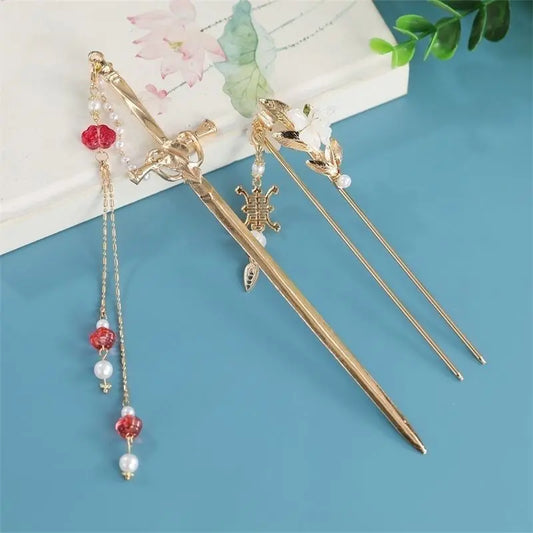
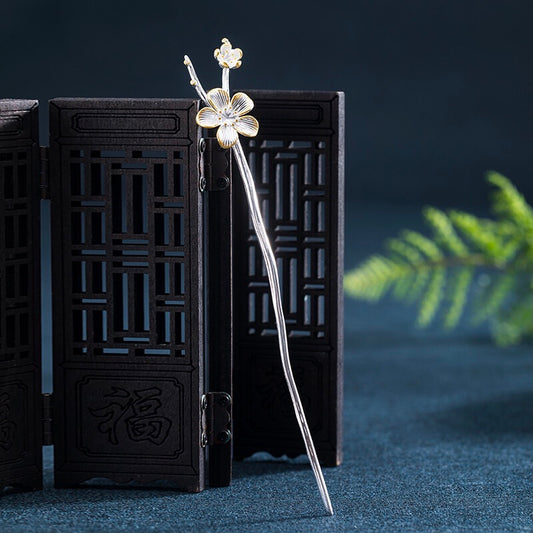
🏮 Chopsticks and hairpins share a common ancestor. Traditional Chinese hairpins (zān) are essentially long, decorated chopsticks — often made of jade, silver, or gold — worn by women for centuries. Explore jewelry that connects you to this daily tradition.
📌 Frequently Asked Questions (FAQ)
• “Chopsticks: A Cultural History.” Q. Edward Wang (2015). Reaktion Books.
• “Why Do Chinese Use Chopsticks?” China Educational Tours (2025).
• “Chopsticks – History and Cultural Significance.” Travel China Guide (2026).
• “Why Do Chinese People Use Chopsticks?” China Highlights (2025).
• “The History and Etiquette of Chopsticks.” Asia Society Education.
• “Chopsticks.” Encyclopaedia Britannica (2025).
• “What Are Chopsticks Used For in China?” The Woks of Life (2020).
• “Why Are Chopsticks Used in China?” Chinese Food History (2024).
🔗 Explore more Chinese cultural heritage at Chinese Showcase.
✨ Traditional Chinese Jewelry — From Chopsticks to Hairpins
The humble chopstick has a refined cousin: the traditional Chinese hairpin (发簪, fàzān). Made from the same materials — jade, silver, gold, wood, and tortoiseshell — hairpins are essentially decorative chopsticks worn by women for over 2,000 years. Our collections celebrate this connection, featuring jade and silver hairpins that could almost double as elegant chopsticks. Wear a piece of history, or gift a pair of chopsticks at a wedding for lasting harmony.
✨ Each piece reflects the same harmony, craftsmanship, and cultural depth as the chopstick — a simple tool that holds 3,000 years of wisdom.