
Taoism Guide
Explore the meaning of the Dao and the religious traditions shaped by China’s temples, communities, and classical writings.
Read the full Taoism guide
The Way and Its Traditions
Taoism, also spelled Daoism, is a Chinese religious and philosophical tradition centered on the Dao, or the Way. Its communities developed scriptures, temples and rituals, while symbols such as the Eight Trigrams and the Northern Dipper connect religious practice with a wider view of the cosmos.
Cover detail from Daoist Immortals in a Landscape, The Metropolitan Museum of Art, 1983.357.Explore Taoist traditions
- The Dao and Its Classics
Begin with the Dao and wuwei, then see how Laozi and Zhuangzi shaped later readings of the Way.
- History and Lineages
Trace the Celestial Masters and explore the Zhengyi and Quanzhen traditions.
- Sacred Mountains and Temples
Explore the temples and pilgrimage traditions associated with Wudang, Qingcheng, Longhu and Qiyun.
- Gods and Immortals
Meet the Three Pure Ones, the Jade Emperor, Zhenwu and the Eight Immortals.
- Festivals and Ritual Objects
Find the dates and meanings of the Three Yuan festivals. Read about offerings, robes, talismans and command tablets.
- External Alchemy and Gunpowder
Trace the historical connection from an early alchemical warning about fire to Northern Song records.
Taoist Symbols and Their Meanings
Some symbols come from Daoist rites and deity traditions. Others, including yin and yang, also belong to the wider culture of China. Their setting helps explain how to read them.
- Yin and YangTaijitu
-
The familiar interlocking diagram depicts yin and yang as complementary, changing qualities. Daoist texts and art use this principle, which also appears throughout Chinese philosophy.
- Eight TrigramsBāguà
-
The Bagua are eight patterns made of three unbroken or broken lines. Known from the Book of Changes (Yijing), they appear in Daoist cosmology, ritual art and divination.
- Northern DipperBěidǒu
-
The seven stars of the Northern Dipper mark a recognizable northern sky pattern. In Daoist traditions, the Dipper also has ritual associations with the ordering of time and human destiny.
- XuanwuBlack Tortoise
-
A tortoise entwined with a snake represents the north among the Four Symbols. Daoist images of Zhenwu, the Perfected Warrior, often show the animals at the deity’s feet.
- Shan Gui Charm CoinShānguǐ huāqián
-
Shan Gui charms take the form of a coin, often with a square central hole. Some pair a thunder invocation with the Eight Trigrams, bringing Daoist ritual language into portable folk objects.
- Hulu GourdHúlú
-
The gourd was a useful vessel as well as a literary and artistic motif. Li Tieguai, one of the Eight Immortals, is often depicted carrying a gourd associated with elixirs or medicine.
- Heavenly OfficialTiānguān
-
The Heavenly Official is one of the Three Officials of Heaven, Earth and Water. Daoist festival traditions associate him with granting blessings, particularly at Shangyuan, the first of the Three Yuan observances.
- CraneHè
-
The crane evokes longevity in Chinese art. In Daoist imagery it may accompany or carry an immortal, as in scenes of Shoulao, the god of longevity, riding a crane.
- Eight ImmortalsBāxiān
-
Each of the Eight Immortals can be recognized by an attribute such as a sword, flute, flower or gourd. In decorative art, the attributes sometimes stand in for the figures themselves.
Collection references include The Met’s Theatrical Robe with Eight Trigrams, Star Deities of the Northern and Central Dippers, Daoist Deity Zhenwu and Tray with Daoist Figures.
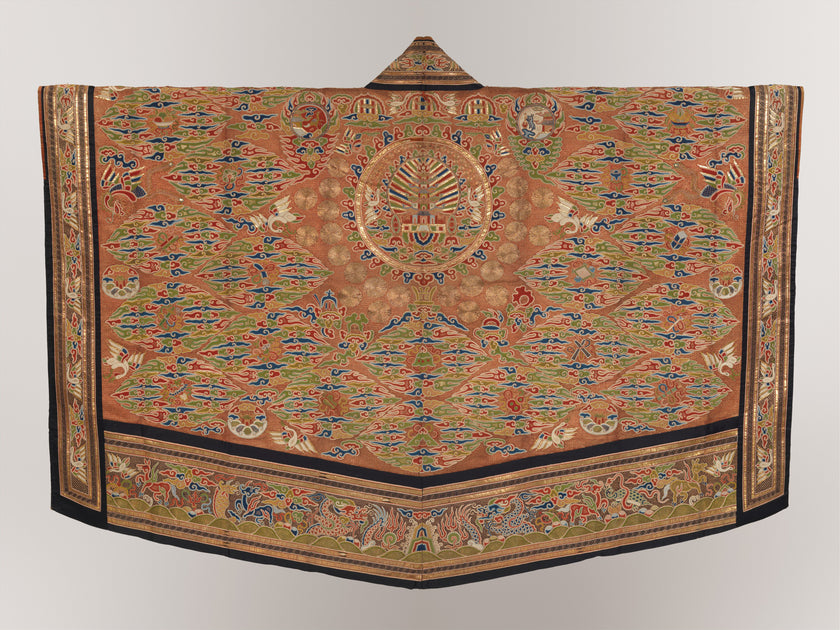
The Robe as a Map of Heaven
The back of this Qing ceremonial robe depicts a celestial palace beneath the sun and moon. Cranes and clouds fill the surrounding field.
The Metropolitan Museum of Art, collection 30.75.3.Explore the artworkRelated Reading
-
The Northern Dipper
See how the seven stars are associated with worship, time and destiny in Chinese traditions.
-
Xuanwu and Zhenwu
Follow the northern tortoise-and-snake motif and its connection to the Perfected Warrior.
-
The Shan Gui Charm Coin
Look at how ritual language and the Eight Trigrams appear on Chinese charm coins.
-
Zhongyuan Festival
Explore the Daoist, Buddhist and local observances that share this season of remembrance.
-
Gourd Symbolism
Follow the gourd as a vessel, an emblem of immortals and a motif in decorative art.
-
Jewelry with Taoist Motifs
Recognize the Eight Trigrams and other Daoist imagery used in wearable designs.
Jewelry with Taoist Symbols
Silver rings, pendants and hair ornaments bring the Northern Dipper, the Eight Trigrams, Xuanwu and other Daoist motifs into contemporary jewelry.
-
Yin and yangRotating Yin-Yang and Bagua Necklace
A pendant pairing the yin-yang diagram with the Eight Trigrams.
-
Heavenly OfficialHeavenly Official Silver Pendant
A silver bar pendant inspired by Tianguan, the Heavenly Official.
-
GourdOpenable Cloud Gourd Necklace
A cloud-patterned gourd pendant opens to reveal a miniature tea room.


Frequently Asked Questions
Are Taoism and Daoism the same?
Yes. Daoism follows modern Pinyin. Taoism reflects the older Wade–Giles spelling. Both refer to the same Chinese tradition.
What is the Dao in Taoism?
The Dao, often translated as the Way, is the source and course of things. Daoist texts connect it with how people live, govern and cultivate themselves.
What festivals do Taoists celebrate?
The Three Yuan observances honor the Officials of Heaven, Earth and Water. Temples also celebrate birthdays of deities and lineage figures. Dates and customs vary by community.
What is the best-known symbol of Taoism?
The interlocking yin-yang diagram, called a taijitu, is one of the best-known symbols associated with Taoism. Daoist art also uses the Eight Trigrams, the Northern Dipper and figures such as Xuanwu.
What is the difference between yin and yang and the Bagua?
Yin and yang describe complementary qualities in change. The Bagua are eight three-line diagrams, each built from a different arrangement of solid and broken lines.
What does wuwei mean in Taoism?
Wuwei is often translated as non-action or effortless action. The Daodejing presents it as a way of acting without needless force, in keeping with how a situation unfolds. Explore the Dao and wuwei
Do Taoists believe in gods?
Many religious Daoist traditions honor deities such as the Three Pure Ones, the Jade Emperor and Zhenwu. The figures honored in a particular temple or ceremony depend on the place, lineage and occasion. Explore Daoist gods and immortals
What does the Northern Dipper mean in Taoism?
In Daoist traditions, the Northern Dipper is associated with celestial order, human lifespan and destiny. In ritual paintings its stars can take the form of Star Lords. Read about the Seven Stars of the Northern Dipper
How can you identify a Shan Gui charm coin?
Look for a coin-shaped body, often with a square hole, and inscriptions associated with Daoist thunder rites. Some examples show the Eight Trigrams on the reverse. See how to read a Shan Gui coin
How are Taoism and Buddhism related in China?
Daoism and Buddhism developed their own teachings and lineages, while influencing each other in rituals, art and temple life. Daoist Zhongyuan and Buddhist Yulanpen observances both contribute to seventh-lunar-month remembrance customs in some communities. Read about Buddhist and Daoist exchange
Explore Buddhist translations, temple life, sacred art and devotional traditions.