The Chinese Showcase journal Chinese symbols
Two Dragons Playing with a Pearl Meaning
Why do two Chinese dragons circle a pearl? Explore the motif’s meaning through palace paintings, a Ming crown, and a Qing bracelet that holds one pearl between two dragons.
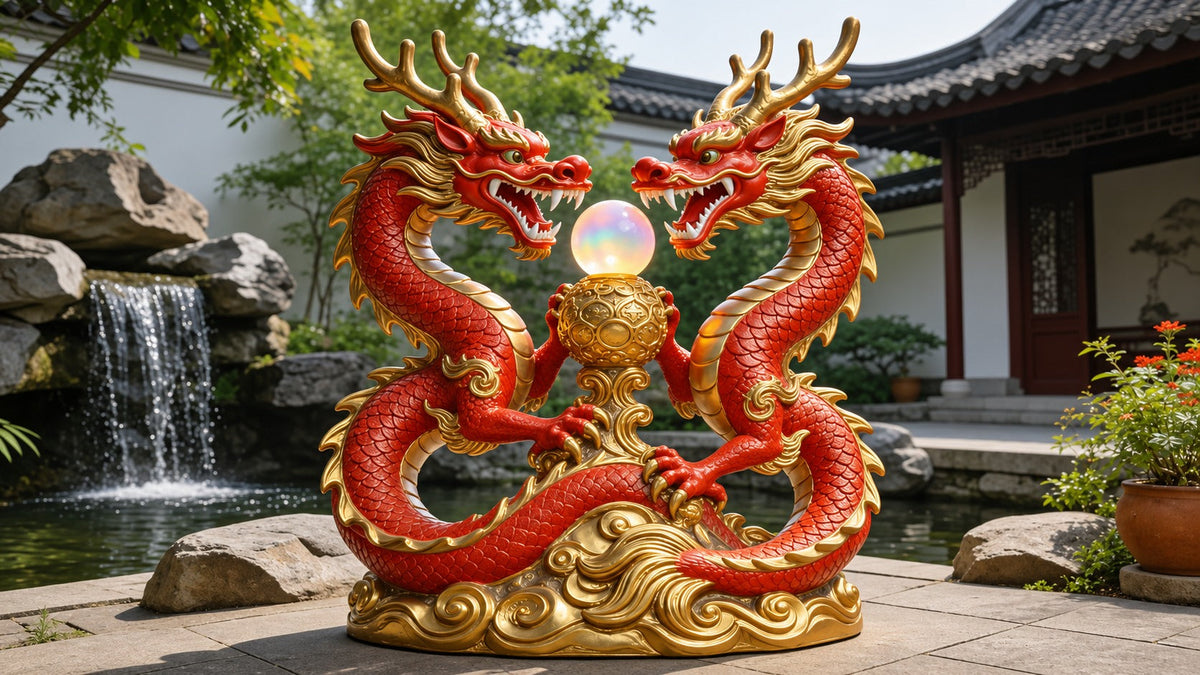
Two Dragons Playing with a Pearl is a traditional Chinese motif in which two dragons face, chase, or hold the same jewel. Called shuanglong xizhu or erlong xizhu, it expresses wishes for good fortune. Its meaning shifts with its setting. On a palace beam it can convey imperial dignity, while a piece of jewelry with two dragons holding one pearl can suggest a shared purpose.
The Motif at a Glance
| English name | Two Dragons Playing with a Pearl |
|---|---|
| Chinese names in pinyin | Shuanglong xizhu and erlong xizhu |
| How to identify it | Two dragons direct their heads or claws toward the same pearl, often ringed with flames. |
| Common meanings | Good fortune, imperial dignity in court settings, and shared purpose in modern jewelry. |
How the Two Dragons Frame the Pearl
Start with the space between the dragons' heads. A small gap can make the jewel look as if it is moving just out of reach. Bring both mouths to the jewel and the gesture becomes one of holding. A ring of flame singles out the round pearl against the winding bodies. The flaming pearl motif also appears with single dragons and in other designs.

A late Ming cloisonné panel at the Metropolitan Museum of Art shows dragons pursuing a flaming jewel through clouds. Thin metal strips divide the surface into cells filled with colored enamel. Follow the outlines closely and you can see where each body turns through the clouds. The long panel gives the pursuit room to unfold. [1]
A carved lacquer box from the Wanli reign, now at the Palace Museum in Beijing, fits the scene into a round lid. The dragons curve along the edge of a circular field, their heads at different heights. The carver cut through layers of red, green, and yellow lacquer to bring out the dragons, the water pattern, and the ground beneath it. The curves of the bodies lead the eye back to the pearl. [2]

Where Does the Dragon Pearl Come From?
The “Lie Yukou” chapter of the Zhuangzi tells of a young man from a family of mat weavers who brings back a pearl worth a fortune. His father tells him a jewel that valuable must have been beneath the chin of a black dragon at the bottom of a deep pool. He could only have taken it while the dragon slept. The story makes the pearl desirable because of where it is hidden and what the young man risks to reach it. [3]
Art historian Hsieh Ming-liang traces visual combinations of dragons and pearls to the Northern and Southern Dynasties. He links the jewel in these images to the Buddhist wish-fulfilling jewel, known as a cintāmaṇi. In later court art, the jewel became an auspicious motif in its own right. Bringing two dragons into the scene gave artists another way to draw attention to it. [4]
The Dragon Motif in Chinese Architecture
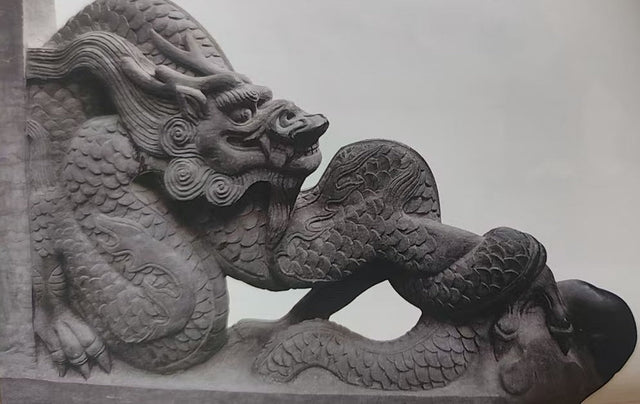
A sandstone railing post from Western Xia Tomb No. 6, now held by the Ningxia Museum, shows how carving can make a dragon seem to move. Shallow relief spans three faces of the post. As you move around a corner, a section of the dragon's body disappears and the next comes into view. This winding form is also characteristic of the Chinese coiling dragon. [5]
A palace beam gives the paired dragons a long, flat space to fill. In the highest-ranking form of hexi painting, known as Gold Dragon Hexi, the central panel often shows two dragons playing with a pearl, with ascending and descending dragons in the end panels. From a distance, the central pearl anchors the design. Up close, the clouds, scales, and flames give the dragons their movement. [6]

Dragons and Pearls on Chinese Vessels
A blue-and-white dish in the Guangdong Museum carries a Guangxu reign mark of the Qing dynasty. Inside, two dragons circle a pearl. On the outer wall, two striding dragons follow the curve of the dish. Look down into the vessel and the pearl brings the design to a focus. Turn the dish in your hands and the outer dragons carry the eye along the rim. [7]

A nineteenth-century export bowl in the same collection shows another use for the pearl. Dark green glass shows through the openwork of its silver stand, behind the dragons and clouds. Between the two dragons sits an unusually broad pearl with a smooth face. The museum suggests that the space may have been left for the buyer to engrave a crest or other emblem. On an object made for the European market, the center of the Chinese design could also carry the owner's mark. [7]
Paired Dragons on a Ming Crown and a Qing Bracelet
A Ming dynasty liangguan, or beam-shaped crown, in the Hong Kong Palace Museum shows how a jeweler could make the scene move. The crown is worked in gold wire and set with rubies. Small springs attach the dragons' necks and the flaming pearl to the crown, so these details tremble as the wearer walks. Ming portraits show women of rank wearing crowns of this type over a hairnet with decorative pins. [8]
On a Qing gold bracelet in the National Palace Museum in Taipei, the two dragons face one another and grip a single pearl between them. Their bodies follow the oval band. As the wrist turns, the gold catches the light and the pearl gives a softer reflection at the center. The same placement carries over to Chinese dragon bracelets in silver, where paired dragon heads can define the opening of the band. [9]
What Do Two Dragons Playing with a Pearl Symbolize?
On a palace beam, the ordered arrangement of paired dragons could reinforce the dignity of the space. On a bowl, box, or piece of jewelry, the same image could express a hope for good fortune. These associations draw on the wider tradition of Chinese dragon symbolism, where dragons are linked with rain, prosperity, and ceremonial authority.
Designs in which the dragons hold the pearl together invite a further reading. The two bodies come from separate directions, yet both mouths support the same jewel. On a piece of jewelry given today, that detail can express a wish to look after something together. The meaning comes from the gesture the artist chose to depict.
Related Chinese Dragon Jewelry
Explore the pearl at the center of a pendant, a pair of facing dragon heads on a bracelet, and bead accents on dragon earrings.

Dragon and Pearl Fine Silver Pendant
Clouds and dragons curve around the pearl motif on this round pendant in 999 fine silver.

Double Dragon Head Fine Silver Bracelet
Two dragon heads face one another across the opening of this 999 fine silver bracelet. A scale pattern follows the curve of the band.

Dragon Motif Earrings with Bead Accents
Curved dragon forms frame small bead accents in blue and gold-tone designs.
Frequently Asked Questions
What does a dragon holding a pearl mean?
A dragon holding a pearl brings together two signs of good fortune. The dragon can convey authority, and the pearl stands out as something precious. On a Qing gold bracelet, two dragons hold a single pearl between their mouths. [9]
What do two dragons symbolize?
In palace decoration, paired dragons can express imperial authority and lend a ceremonial symmetry to the design. When they support the same pearl, a modern reading is that both are caring for something they value.
What does a double dragon mean?
A double dragon is a motif with two dragons. They may face one another, move in the same direction, or coil around the same point. The name Two Dragons Playing with a Pearl applies when the pair centers on a pearl. See how the composition curves around the wrist in these Chinese dragon bracelet examples.
What is a pearl dragon?
The phrase can describe a dragon pictured with a pearl. In Chinese decorative art, dragon pearl refers to the jewel shown near the dragon's mouth or claws. The jewel may be carved, painted, or made from an actual pearl.
Why do dragons hold orbs?
A round jewel gives the dragon's gaze and sweeping body a clear point of focus. A ring of flames makes the jewel easy to pick out among clouds and scales. That device is especially visible in dragons playing with a flaming pearl.
What is the history of the dragon pearl?
An early story in the Zhuangzi places a precious pearl beneath a black dragon's chin. In the history of the image, Hsieh Ming-liang traces dragon-and-pearl designs to the Northern and Southern Dynasties and relates the jewel to the Buddhist wish-fulfilling pearl. [3] [4]
Are dragons good luck or bad luck?
Chinese dragons often signify good fortune in decorative art. They also have associations with rain and imperial power. Their meaning varies with the setting, as the guide to Chinese dragon symbolism explains.
What is happening in the Two Dragons Playing with a Pearl motif?
It depends on the object. The Ming cloisonné panel shows the dragons chasing a jewel through clouds. The Qing gold bracelet shows both of them holding it at once.
Sources
- The Metropolitan Museum of Art, Panel with Dragons amid Clouds, late Ming dynasty, object no. 29.110.94.
- The Palace Museum, Beijing, Carved Polychrome Lacquer Box with Two Dragons Playing with a Pearl, Wanli reign, Ming dynasty.
- Zhuangzi, “Lie Yukou,” the story of the pearl beneath the black dragon's chin.
- Hsieh Ming-liang, “The Dragon and the Dragon Pearl”, National Taiwan University, no. 52 (2022).
- China Grand Canal Museum, exhibition of the Western Xia imperial tombs, dragon-carved railing post from the Ningxia Museum collection.
- The Palace Museum, Beijing, glossary entry on Gold Dragon Hexi painting.
- Guangdong Museum, blue-and-white dish with paired dragons and a Guangxu reign mark, and nineteenth-century bowl with a silver openwork stand depicting two dragons and a pearl.
- Hong Kong Palace Museum, Ming dynasty crown with dragons chasing a pearl, featured in Radiance.
- National Palace Museum, Taipei, Gold Bracelet Decorated with Paired Dragons Playing with Pearls, Qing dynasty, object no. 007591.
The cover illustration and the images in the article show variations on the motif and the ways it fits different objects.
Stories, symbols and everyday objects
Our journal explores Chinese culture and design. Traditions and interpretations vary by region and source. For a purchase, use the specifications on the individual product page.
About Chinese ShowcaseQuestions or corrections? Contact us ↗