The Chinese Showcase journal Jewelry Knowledge
Qing Dynasty Dragon Bangles in Silver, Enamel, and Vine
Two dragons face a raised pearl on these Qing dynasty bangles. Explore the silver mounts, colored enamel, and dark feng teng vine that shape the pair.
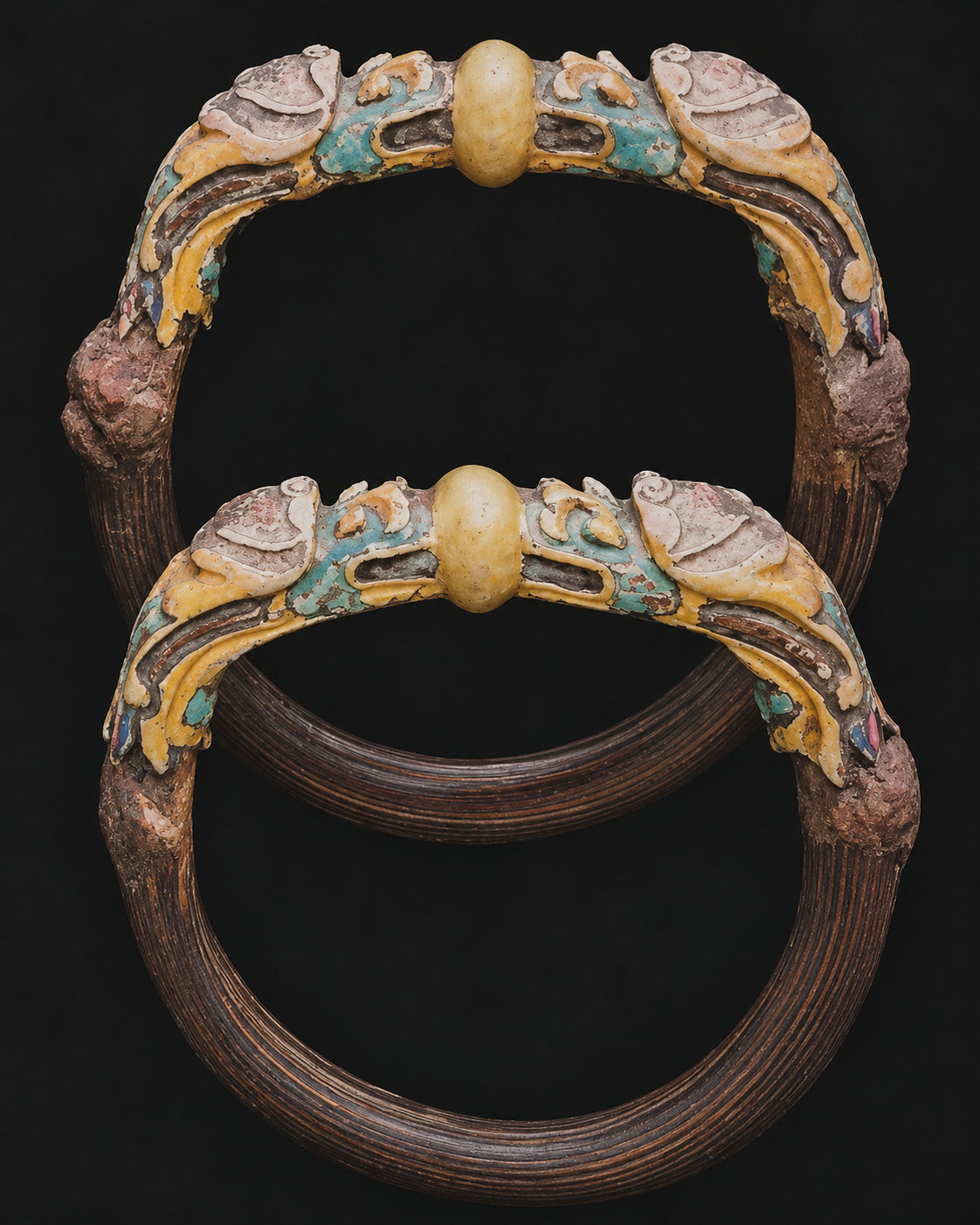
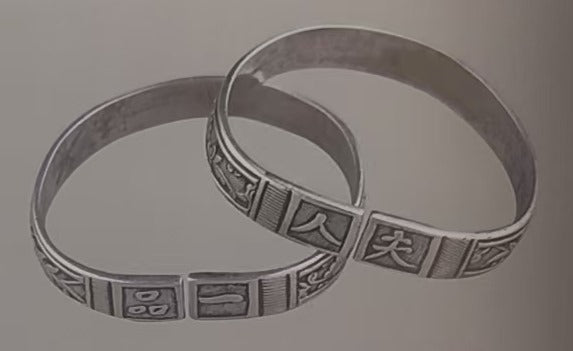
Qing dynasty dragon bangles could combine metalwork with the natural texture of a vine. In the pair shown here, dark feng teng vine forms each band. A silver mount carries colored enamel and Two Dragons Playing with a Pearl across the front. Wang Jinhua records the pair under Beijing in Chinese Traditional Jewelry: Bangles, Rings, and Earrings. The catalogue gives a diameter of 7 cm and a weight of 40 g per bangle.
Look first at the pale yellow raised motif at the center of each mount. Blue-green, cream, and pale pink details extend to either side, then give way to long ridges along the brown vine. The catalogue identifies the period as Qing and lists Beijing as the region. The workshop and original wearer remain unknown.

Compare with the original catalogue photograph

What Is a Silver-Mounted Vine Bangle?
A silver-mounted vine bangle has a band formed from vine and silver fittings that cover selected areas. The Chinese description yin bao teng refers to the way metalwork wraps part of the vine. Wang calls the body of this pair feng teng (风藤). He describes a woody vine with visible grain and nodes. Its exact botanical species remains unconfirmed.
The catalogue photograph makes the relationship between the two materials easy to read. The vine forms most of each ring, and fine lengthwise lines follow its curve. At the front, a wider silver mount gives the dragons and central motif room to be seen. The ends of the mount taper into the darker band, where the natural texture takes over.
Silver mounts can also serve a structural purpose. A Qing butterfly-pattern vine bangle in the Kaohsiung Museum of History was made by forming the vine into a circle, wrapping silver around the joint, and fixing it with rivets. Its silver surfaces carry chased butterflies, flowers, a sword, and a fan. The museum's example shows how a join can become part of the design. The attachment method of the dragon bangles in Wang's book would require examination of the pair.
Wang's catalogue also lists dragon-and-pearl vine bangles on pages 45 and 52. The pair on page 36 is identifiable by its enamel decoration and the paired bands in the photograph. The book records the material as silver, with the precise fineness unspecified.
How Colored Enamel Brings Out the Design
Enamel is a glass-based material that bonds to a surface when fired. On a metal ornament, different colors can follow the contours of a design and make small details easier to read. The term shaolan, often encountered in descriptions of Chinese silver enamel, can cover more than blue decoration. A Qing silver filigree box in the Palace Museum uses translucent blue and green enamel in its foliage.
On the photographed pair, pale yellow draws attention to the raised center and surrounding curves. Small blue-green patches pick out the spaces beside it, with pale pink relief details farther along the mount. As the decorated area narrows, the brighter colors give way to the vine. The catalogue describes this pair as silver-mounted and enamel-decorated. The precise enamel technique, the composition of the raised center, and any gilding would require closer examination.
How Two Dragons Playing with a Pearl Fits a Bangle
In the Two Dragons Playing with a Pearl motif, two dragons face a central pearl. Their movement converges on a shared point, giving this auspicious motif a sense of movement around a stable center. On a bangle, the maker has a narrow strip of curved surface to work with. The raised pearl becomes the easiest feature to spot, while the lines to either side lead around the curve of the wrist.
The printed photograph makes it easier to see the position of the pearl and the arrangement of the two sides than to read every detail of the dragons. Wang's title and description identify the subject. Each bangle has its own complete two-dragon design. Set one behind the other, the two central ornaments and their spreading curves echo each other, while the vine ridges vary from one band to the next.
A Qing Silver Bangle with the Same Motif
A Qing silver bangle in the Palace Museum uses Two Dragons Playing with a Pearl in a different construction. Its gilt silver filigree forms the two dragons, and the opening sits at their heads. The wearer withdraws a pin at the dragon's mouth to open it. On that object, the position of the dragon heads tells you how the clasp works.
On Wang's pair, the eye follows the edges of the colored mount to the exposed vine. The contrast is visible before the details of the design come into focus. Both objects put the dragons at the front, adapting the motif to their materials and construction. For another example of close reading a period wrist ornament, see our guide to Qing dynasty silver bangles and the Yipin Furen inscription.
What to Look for When the Two Bangles Are Together
Look at the ornaments first. The central shapes sit in corresponding positions, and the enamel occupies a similar length of each band. Then look at the exposed vine. Fine ridges follow the arc of each loop and catch the light at the lower edge, where the vine is most exposed. This contrast gives two small objects both a strong center and room for quiet detail. The front carries the wish for good fortune, while the rest of the band keeps the texture of the material in view.
Frequently Asked Questions
What are these Qing dynasty dragon bangles made of?
The catalogue describes feng teng vine bands with silver mounts and colored enamel decoration across the front.
What is feng teng in a Chinese vine bangle?
Feng teng is Wang Jinhua's term for the woody vine used to form the band. The catalogue leaves the precise botanical species unspecified.
Is the raised pearl on each bangle a real pearl?
The raised pale yellow center represents the pearl in Two Dragons Playing with a Pearl. Its material remains unconfirmed.
How large are the two Qing bangles?
The catalogue gives a diameter of 7 cm and a weight of 40 g for each bangle.
Dragon and Enamel Jewelry
-

Fine Silver Double Dragon Bracelet
Two sculpted dragon heads face each other across a 999 fine silver band.
-

Blue Enamel Floral Silver Bangle
Blue enamel picks out the floral pattern on this Qing-inspired silver clasp bangle.
-

Blue Filigree Dragon Earrings
Gold-plated dragon hoops with blue enamel detail and pearl-like accents.
References and Further Reading
- Wang Jinhua. Chinese Traditional Jewelry: Bangles, Rings, and Earrings. China Textile & Apparel Press, 2014, pp. 36, 45, 52. Catalogue illustration, measurements, and related entries. ISBN 9787518003389.
- Kaohsiung Museum of History. Silver-Mounted Vine Bangle with Butterfly Designs, Qing dynasty. Collection no. KH2001.037.0032. Comparative record for a vine band with riveted silver mounts.
- Palace Museum, Beijing. Silver Filigree Box with Enamel, Qing dynasty. Collection no. Gu 00137786. Comparative record for blue and green enamel on silver.
- Palace Museum, Beijing. Silver Bangle, Qing dynasty. Collection no. Gu 00071656-2/19. Comparative record for a gilt silver filigree version of Two Dragons Playing with a Pearl.
Stories, symbols and everyday objects
Our journal explores Chinese culture and design. Traditions and interpretations vary by region and source. For a purchase, use the specifications on the individual product page.
About Chinese ShowcaseQuestions or corrections? Contact us ↗