The Chinese Showcase journal Jewelry Knowledge
Double Dragon-Head Jade Huang from the Spring and Autumn Period
Two dragon heads and three small holes tell the story of how a Spring and Autumn jade huang was shaped, decorated, and made to hang.
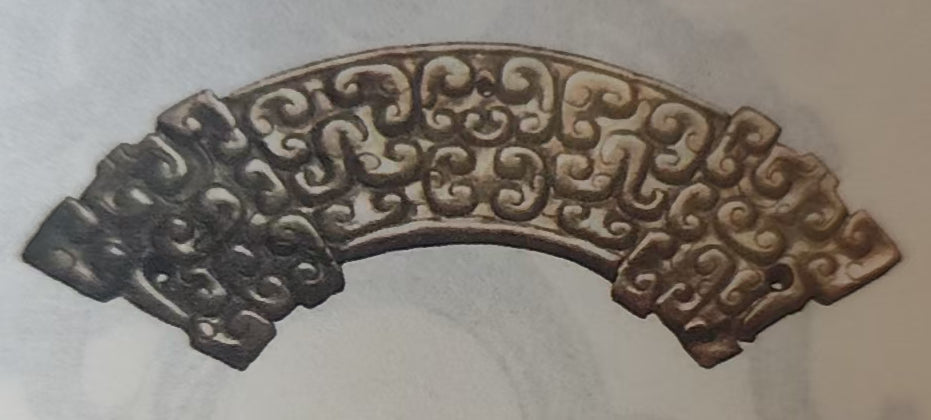
A jade huang (玉璜, yù huáng) is an arc-shaped Chinese jade ornament. On the Spring and Autumn period example shown here, a dragon head marks each end, paired whorls fill the curved face, and three small holes give clues to how it could be strung. Decorations and attachment points share the same narrow piece of jade.
The book illustration reproduced here is titled Double Dragon-Head Jade Huang. Its stepped end profiles, three holes, and arrangement of whorls closely match the photographs of a piece in the Shanghai Museum. The museum records its dimensions as 10.6 cm long and 3.0 cm wide and features it as a late Spring and Autumn work. The book illustration’s publication details remain unconfirmed.
What Is a Jade Huang?
The old dictionary Shuowen Jiezi describes a huang as half of a bi, the round jade disc with a central opening. That comparison gives a useful starting shape. Examples vary in the depth and length of the arc. The curved front gives the carver room for ornament, while small holes can allow the piece to hang by itself or connect it to other components.
On the double dragon-head piece, smooth inner and outer curves define the middle of the arc. Near the ends, the edges widen and turn into flat steps and notches. This makes the head at either end visible in silhouette before the carved details come into focus. An earlier Shang dynasty jade huang offers another way to see how varied this basic form could be.
Two Dragon Heads and a Field of Whorls
The dragons face outward. At each end, short projecting edges shape the head. Between them, broad curling hooks and smaller whorls follow one another along the arc. Some turn inward in pairs. Others tuck into the spaces between larger curls. A narrow border follows the curve and keeps the crowded pattern within the face of the ornament.

The Shanghai Museum classifies the decoration as dragons and whorls and records the techniques as grinding and relief carving. From a distance, the silhouette carries the two heads. Up close, the turns and spacing of the whorls give the middle of the piece its character. A Spring and Autumn dragon-pattern jade jue shows how closely the design of a dragon could follow a different jade form.
What the Three Holes Can Tell Us
There is a round hole near each end and a smaller one near the middle of the outer arc. A cord through the end holes could spread the load across two points. A central hole could offer a separate point of suspension or connection. Different cord arrangements could change the way an arc hangs. The book photograph shows positions that can be studied, and the original arrangement remains uncertain.
A Spring and Autumn Green Jade Dragon-Head Huang excavated in 1988 from the tomb of Huang Jituofu in Guangshan, Henan, provides a comparison. It has a dragon head at each end, and the Henan Museum describes the two small end holes as points for threading a cord. Its decorated face has bird and animal motifs, and its other side is plain. With an excavated piece, the holes, surfaces, and archaeological record give several kinds of evidence for understanding its use.
How Huang Fit Into a Jade Pendant Set
A composite jade pendant could combine pieces of different shapes and materials. An arc-shaped huang spreads across the body, while strings of beads and tubes connect the next pieces below it. Archaeological finds preserve some of these arrangements.
The late Western Zhou Seven-Huang Jade Pendant Set from tomb M2001 in the Guo State cemetery at Sanmenxia is about 126 cm long. Its seven arcs get larger from top to bottom and are joined by rows of red agate beads and tubes and light blue glass beads. Some of the agate bead holes still held traces of red thread when excavated. Those traces and the placement of the components explain how separate small ornaments once formed a single piece that hung from the neck.
Jade Huang in Ritual and Dress
The Rites of Zhou names a dark jade huang among the six jades used to honor heaven, earth, and the four directions and associates it with the north. The Book of Rites, in its Yuzao chapter, describes how pendants sounded as their wearer walked and turned. The texts place jade in different settings, from ritual offerings to formal dress.
Return to the photo and follow the arc from one dragon head to the other. The stepped outlines open out at the ends, then give way to smooth borders and closely spaced whorls in the middle. On a piece only about the width of a hand, the relief and the carved arc shape the ornament, while the holes leave several ways to connect it.
Frequently Asked Questions
What does jade huang mean?
A jade huang is an arc-shaped Chinese jade ornament. It is comparable in outline to part of a jade disc and was sometimes strung with other ornaments.
What makes this a double dragon-head huang?
The two ends are shaped as outward-facing dragon heads. The center follows a curved arc and is filled with whorl patterns.
How many holes does the Spring and Autumn jade huang have?
Three holes are visible in the corresponding Shanghai Museum photographs, one near each end and a smaller hole near the middle. The original cord arrangement is uncertain.
What is a seven-huang jade pendant set?
It is a composite ornament containing seven jade arcs. The late Western Zhou example from the Guo State cemetery joins the arcs with rows of agate and glass beads.
When does the Shanghai Museum date its double dragon-head jade huang?
Its collection record dates it to the Spring and Autumn period. The museum’s dragon exhibition feature identifies it as a late Spring and Autumn work.
Related Jade and Dragon Jewelry
These contemporary pieces echo the curve of the jade or the paired creatures.
-

Curved Hetian Jade Phoenix Necklace
A curved white jade pendant with matching enamel phoenixes and five green drops.
-

Two-Dragon Fine Silver Pendant
Two dragons face inward on a round pendant in 999 fine silver.
-

Double Dragon-Head Silver Bracelet
Two modeled dragon heads finish the curved band of this 999 fine silver bracelet.
References and Further Reading
- Shanghai Museum, Double Dragon-Head Jade Huang, CI00004488. Collection record and the museum’s dragon-themed exhibition feature.
- Xu Shen, Shuowen Jiezi, jade radical, entry for huang.
- Henan Museum, Dragon-Pattern Jade Huang, collection essay on jade huang types, ornament, and uses.
- Henan Museum, Green Jade Dragon-Head Huang, excavated at the Huang Jituofu tomb, Guangshan, 1988.
- Henan Museum, Seven-Huang Jade Pendant Set, late Western Zhou, Guo State cemetery M2001, Sanmenxia.
- Rites of Zhou, Da Zongbo. Book of Rites, Yuzao.
Stories, symbols and everyday objects
Our journal explores Chinese culture and design. Traditions and interpretations vary by region and source. For a purchase, use the specifications on the individual product page.
About Chinese ShowcaseQuestions or corrections? Contact us ↗