The Chinese Showcase journal Chinese symbols
What Is a Coiling Dragon in China?
Known as Panlong, the coiling dragon curls into a ring or winds around a support. Follow this Chinese dragon motif from early ritual vessels and jade rings to palace ceilings.

A coiling dragon in China is a dragon whose long body bends into a loop or winds around a support. In Chinese it is called Panlong. On a bronze dish, the dragon may lie curled around the center. In a palace, it can spiral up a column or fill the space above a throne. The posture can suggest readiness, and the setting can give the dragon a ceremonial or imperial meaning.
The coiling dragon at a glance
| Chinese name | Panlong (pánlóng) |
|---|---|
| How to recognize it | A long body curled inward, looped into a ring, or wrapped around an object |
| Where it appears | Painted pottery, ritual bronzes, carved jade, Buddhist sculpture and palace architecture |
| Cultural associations | A dragon yet to ascend in early lore, imperial dignity in palace settings, and readiness in modern interpretations |
What does Panlong mean in Chinese?
In Panlong, pan means to coil or wind around, and long means dragon. The Song dynasty encyclopedia Taiping Yulan, quoting the earlier glossary Fangyan, calls a dragon that has yet to ascend to heaven a panlong. That idea of a dragon waiting to rise helps explain why the motif can suggest strength held in reserve.
The same volume preserves a description from Shen Huaiyuan’s Nanyue Zhi of a dragon marked with red bands like figured silk that moves downstream into the sea. Early writers pictured the dragon in relation to both water and sky. In art, the length and flexibility of the body give the maker a way to fit it into a vessel, a ring, or a setting that draws the eye upward. [1]
From painted pottery to a dragon in bronze
About four thousand years ago, artists at Taosi, in present-day Xiangfen, Shanxi, painted dragons inside earthenware dishes. Red pigment brings the curved bodies out against the dark clay surface. The curve of the dish guides the dragon’s shape, with room along the body for markings that resemble scales. Several examples came from large tombs with other carefully placed objects, including drums and stone chimes. Their arrangement offers a glimpse of how these vessels belonged to a wider ritual setting. [2]
On a Late Shang bronze water vessel in the National Palace Museum in Taipei, the dragon’s head rises slightly from the center. Its body curls across the dish while bands of bird, fish and kui designs run around the edge. The vessel is 43 centimeters across at the opening. Seen from above, the pattern gathers around the dragon’s head. Seen from a low angle, the raised features show how the bronze caster used depth as well as outline. [3]
How jade carvers turned Panlong into a ring
A Late Shang jade ring at the Shanghai Museum takes the design a step further. The curled body forms the outline of the ring itself. Its dragon has mushroom-shaped horns and cloud-shaped ears. The dragon bites its own tail at the join, so the creature’s body and the outline of the ornament form a continuous loop. [4]
An early Ming white jade ring ornament in the Palace Museum has a much fuller profile. Cloud scrolls frame the dragon’s claws and streaming mane. Openwork lets light through the carving and makes the fine details easier to distinguish. A slot at the back suggests that the piece may once have been attached to a belt. The way the ring might have been worn is visible in a detail that sits behind the decorated face. [5]
Coiling dragons on trees, columns and ceilings
A Northern Qi Buddhist sculpture dedicated by Zhang Yan in 557 shows a dragon wrapped twice around a tree. From its raised mouth extends a lotus stem carrying a child emerging from the flower. The tree gives the body something to wind around and guides the viewer’s eye to the scene of lotus birth, a theme in Buddhist art. [6]

The Hall of Supreme Harmony in Beijing offers a documented imperial example. Six gilded dragon columns stand beside the throne. The coils draw the eye up the straight columns, while a dragon in the raised ceiling above turns its head down and holds a pearl in its mouth. In a hall used for imperial accession and wedding ceremonies, the size, gilding and placement of the dragons help give the throne its ceremonial presence. [7]
How to tell a coiling dragon from a walking or soaring dragon
Start at the head and trace the body to the tail. A walking dragon (Xinglong) advances in profile with its legs extended in a stride. A soaring dragon (Tenglong) is shown in flight or in the act of leaping. A coiling dragon (Panlong) has a body visibly looped or wound around something. A coiling dragon may also be ascending or descending. [6] [7]

On the Forbidden City’s Nine-Dragon Wall, the Palace Museum describes the nine dragons across the wall as coiling dragons. Several are also identified by direction, with white dragons rising and blue dragons descending. Walking dragons appear along the ridge above. The wall makes it easy to see how a description of body shape can sit alongside a description of movement. [7]
What does a coiling dragon symbolize today?
A coiled body with a lifted head can give the impression that an animal is ready to move. In a modern ornament, that posture can express patience, readiness and the confidence to act at the right time. A dragon that closes around a center, as on the jade ring, can also suggest keeping something valued close. These readings begin with the feature that makes the design recognizable, the long body drawn into a curve.
Dragon jewelry with curling forms
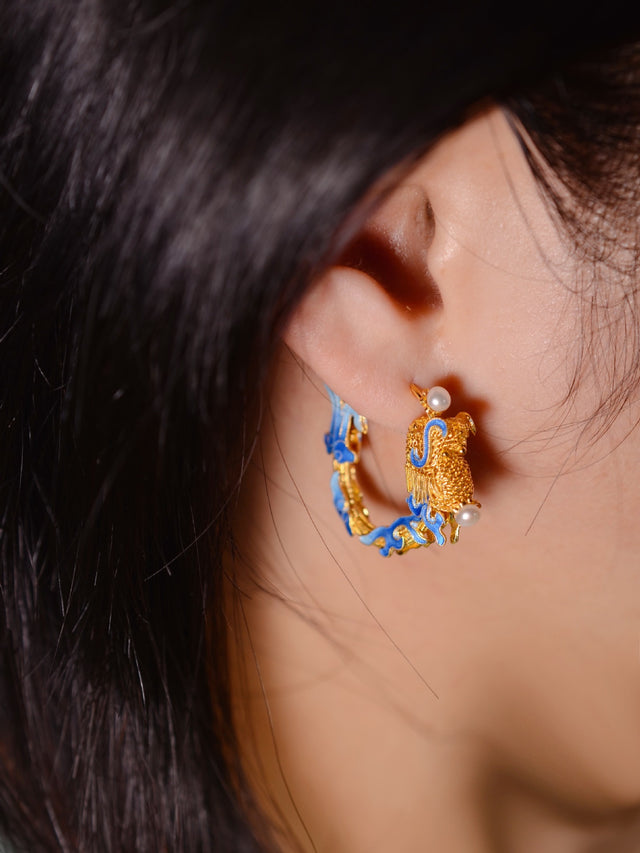
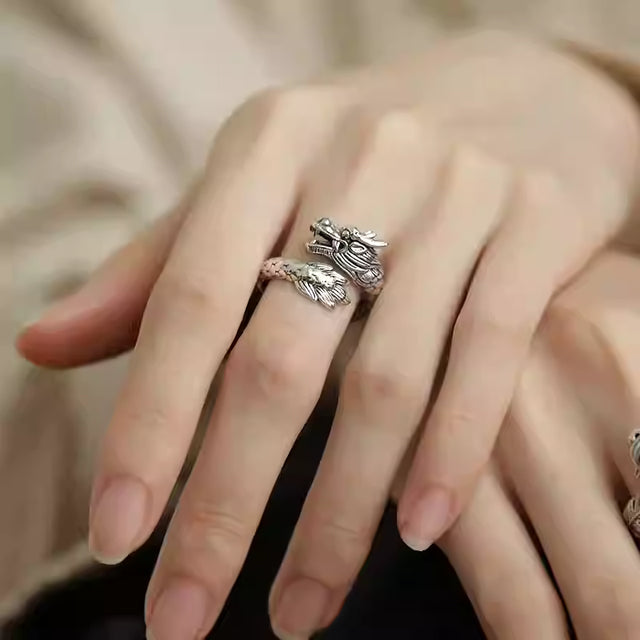
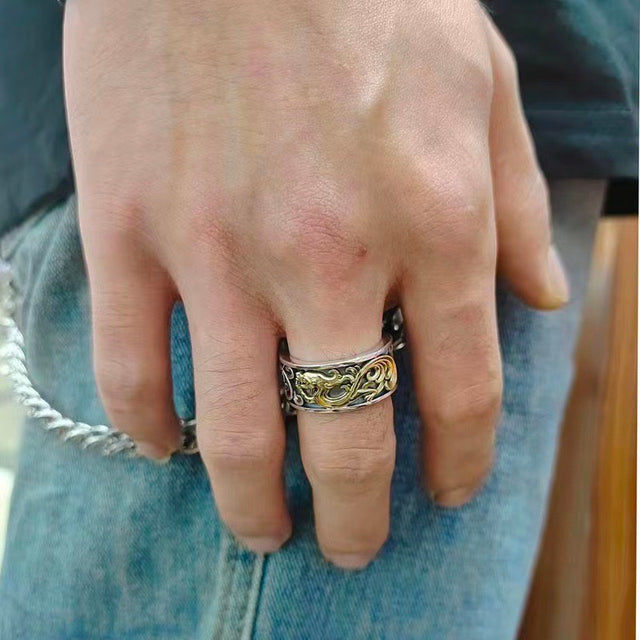
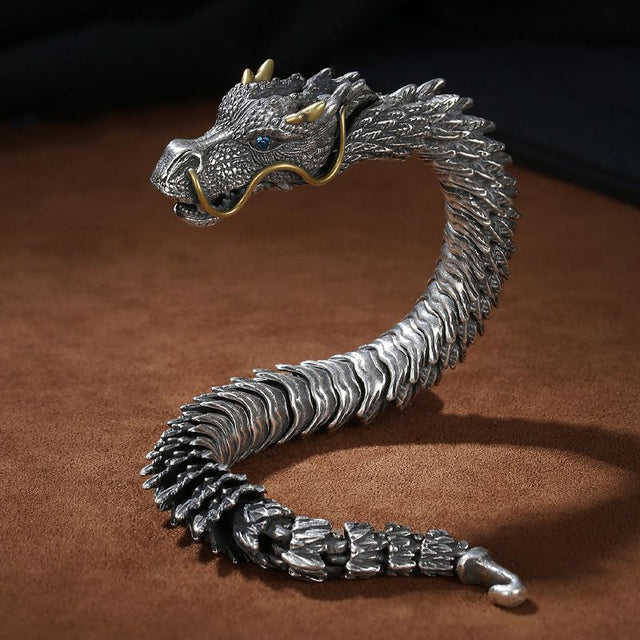
On a ring, cuff or round pendant, the dragon’s long body can follow a curve just as it does on a ritual vessel or a jade ring.

Coiled Dragon Adjustable Ring
A copper open ring with a scaled dragon body that follows the curve of the band.

Double-Headed Dragon Silver Bracelet
Two dragon heads face each other at the ends of a 999 fine silver cuff. The scaled details turn around the band.

Dragon and Pearl Round Silver Pendant
Dragons curl around a pearl inside this round 999 fine silver pendant.
Frequently asked questions
What is a coiling dragon?
A coiling dragon is a Chinese dragon shown curled around itself or a support. Its body may lie in a tight loop on a bronze vessel, form the outline of a jade ring, or spiral up a column.
What does the dragon symbol mean in China?
Chinese dragons have long been associated with water, rain and auspicious power. In imperial settings, the dragon could signify the ruler’s authority. A specific motif takes on meaning through the object it decorates and the other images around it.
What is the Panlong dragon?
Panlong is the Chinese name for a coiling dragon. Pan means to coil or wind around, and long means dragon. A definition preserved in the Song dynasty encyclopedia Taiping Yulan calls a dragon that has yet to ascend to heaven a panlong.
What does a coiling dragon symbolize?
A dragon coiled with its head raised can suggest stored strength and readiness. In a palace, the same kind of curve can express dignity and authority through the scale, placement and finish of the carving.
How does a coiling dragon differ from a soaring dragon?
Coiling describes how the body bends, and soaring describes how a dragon moves through the air. A dragon that twists and loops in flight can fit both descriptions.
Where can you see coiling dragons in Chinese art?
Coiling dragons appear on early painted pottery, Shang bronze water vessels, jade rings, Buddhist sculpture and palace ceilings. In Beijing, the Hall of Supreme Harmony and the Nine-Dragon Wall in the Forbidden City are two well-documented examples.
References
- Li Fang and others. Taiping Yulan, volume 930, citing Fangyan and Shen Huaiyuan’s Nanyue Zhi.
- Liangzhu Museum. Exhibition note on the painted dragon dishes excavated at Taosi.
- National Palace Museum, Taipei. Pan Water Vessel with Coiling Dragon Pattern, Late Shang.
- Shanghai Museum. Jade ring in the shape of a coiling dragon, Late Shang.
- The Palace Museum, Beijing. White jade ring ornament with a coiling dragon, early Ming.
- The Palace Museum. Forbidden City, 2024, no. 2, discussion of coiling and soaring dragons on Buddhist sculpture screens.
- The Palace Museum, Beijing. Architectural entries for the Hall of Supreme Harmony and the Nine-Dragon Wall.
Photographs from the supplied visual references. The cover is cropped from a printed example identified as Xi’an, Shaanxi.
Stories, symbols and everyday objects
Our journal explores Chinese culture and design. Traditions and interpretations vary by region and source. For a purchase, use the specifications on the individual product page.
About Chinese ShowcaseQuestions or corrections? Contact us ↗