The Chinese Showcase journal Chinese symbols
The Variant Cloud-and-Thunder Pattern in Chinese Bronze
Strong hooks, round openings and a tapering silhouette give this variant of the Chinese cloud-and-thunder pattern its distinctive rhythm. Use the illustrated example to see how its curls relate to the familiar squared repeat.
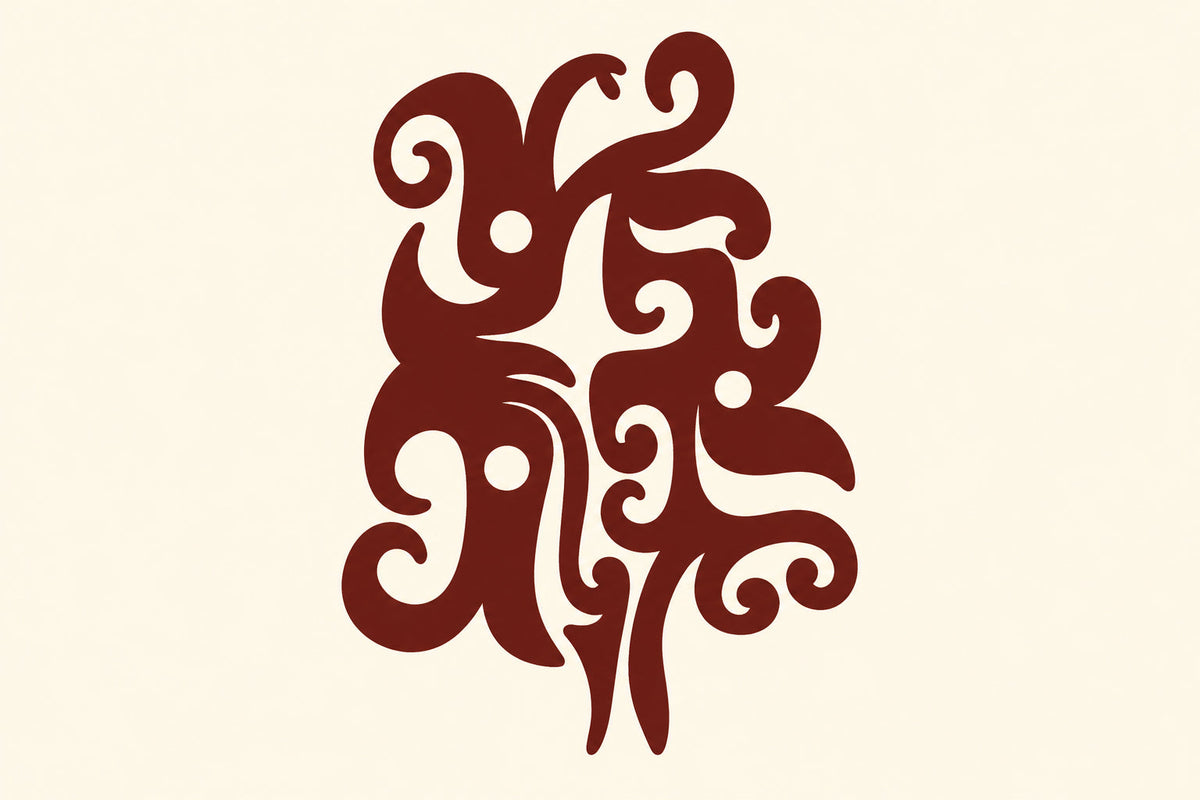
The variant cloud-and-thunder pattern (变形云雷纹, biànxíng yúnléiwén) is a flowing variation on a family of spiral designs found in Chinese bronze decoration. In the design shown here, broad strokes fold inward into tight hooks. Narrow gaps and pale circular openings break up the dark silhouette. The curves gather into a single upright composition.
Hongtang Meixue’s Pattern Design Quick Reference Handbook labels this design item 0005 and places it under the Warring States heading. The caption identifies the material category as 铜器 (tóngqì), a broad term for copper and bronze objects. The illustrated motif gives us a clear design to study. The parent object, its findspot and its precise date remain open. [1]

View the original photograph crop

How to recognize the variant cloud-and-thunder pattern
Begin with the dark outline. At the top, larger round hooks turn back into themselves while a narrower curved tip rises between them. Follow the heavier shapes down the sides and you can see where they swell, narrow and turn again. Two slender points at the bottom pull the silhouette downward. The changes in width give the composition its vertical sweep.
Next, follow the pale spaces. Three small circular openings punctuate the drawing at different heights. Between them, a narrow channel bends through the middle and splits the dark mass into legible curls. These openings are features of the printed design. How they appeared on the bronze would depend on the surface, technique and original setting.
Try tracing a single curve from its wide base to the little hook at its end. Then follow the adjoining pale curve in the opposite direction. Reading both paths makes it easier to see how the forms interlock. The varying spacing gives each turn a different pace even when the hook shape recurs.

How it compares with the squared Yun Lei Wen
The Palace Museum’s glossary describes yunleiwen as a geometric bronze ornament made with recurring turns. In its terminology, a rounded spiral is associated with cloud ornament and a squared spiral with thunder ornament. The handbook’s neighboring example, item 0004, shows the angular version clearly. Its right-angled coils are arranged side by side with consistent spacing, making it easy to imagine the strip continuing around a vessel. [1, 2]
Item 0005 changes the way the eye follows the design. Its hooks curve at different widths, its edge rises and falls, and its thinner ends sweep beyond the denser middle. The resemblance is easiest to see at the curled tips, where each line turns back toward its own center. The difference is clearest at the outer edge. Item 0004 follows an even band, while item 0005 reads as one compact composition. [1]
What museum bronzes tell us about the design family
Actual bronzes let us see how a spiral ornament works alongside a handle, rim or larger field of decoration. On the Palace Museum’s late Western Zhou zhī cup with hanging-scale ornament, a narrow cloud-and-thunder band sits below the neck. Three layers of overlapping scales occupy the body. The band helps articulate the change from the neck to the rounded wall. Its job in the overall design is visible because its placement survives. [3]
The Palace Museum also catalogs a Warring States bronze plaque with cloud ornament, accession Xin 00059849, under both cloud and cloud-and-thunder motifs. A fifth-century BCE bronze serving vessel in the Smithsonian’s National Museum of Asian Art shows another way ornament could be organized. Its body and handles carry interlaced bands, while ducks and small masks decorate the lid. The Smithsonian describes the casting as so precise that its ornament can look engraved. Both pieces give period context for compact and interlaced bronze ornament. The handbook lists item 0005 by design type and material category. [4, 5]
What does a variant cloud-and-thunder motif mean?
The name points to a family of coiling forms. Clouds and thunder are broad associations carried by the traditional terminology. In this design, the visible effect comes from alternating thick and thin strokes and the small intervals between them. An eye following the curls never travels in one direction for long. It keeps turning inward and then finding the next opening. [1, 2]
For a contemporary design, the silhouette could work as a standalone ornament on a pendant, a small plaque or an engraved border detail. Enlarging the gaps makes the hooks easier to distinguish at jewelry scale. A bead or stone can echo one of the round openings. These are modern design choices drawn from what the pattern does on the page.
Two inlaid belt-hook diagrams from the same page show how curves can take different directions. The opposing cloud scroll spreads across a horizontal design, while the cloud-head scroll gathers inward around a pointed outline. [1]
Frequently Asked Questions
What is the variant cloud-and-thunder pattern?
It is a flowing variation of the Chinese yunleiwen spiral family. The illustrated handbook example uses curved hooks, round openings and tapering strokes in a compact upright composition.
How does it differ from squared cloud-and-thunder ornament?
The squared form has regular right-angled turns and is often arranged as a band. Item 0005 uses rounded hooks of varying width and an irregular outline.
Are the round openings holes in the original bronze?
The round openings are visible in the handbook drawing. A photograph or technical record of the original would help identify them as cast openings, inlay or areas defined by surface ornament.
Was the illustrated motif made in the Warring States period?
The handbook groups item 0005 under Warring States patterns and identifies the source as a copper or bronze object. Its precise date and collection remain unconfirmed.
How can I recognize the motif in a modern design?
Look for inward-rolling hooks, a narrow winding gap between darker shapes, and tapered ends. Those features are easier to recognize than color, which can change with the material.
Jewelry with Cloud and Scroll Motifs
These contemporary pieces use details such as curling lines, shaped cloud heads or openwork.


References
- Hongtang Meixue. Pattern Design Quick Reference Handbook (纹样设计速查手册). Posts & Telecom Press, 2024. ISBN 9787115643353. Cloud Patterns, Warring States section, illustration 0005.
- The Palace Museum, Beijing. “Cloud-and-Thunder Pattern” (云雷纹), collection terminology.
- The Palace Museum, Beijing. Late Western Zhou zhī cup with pendant-scale ornament (垂鳞纹卮), accession 故00076989.
- The Palace Museum, Beijing. Warring States bronze plaque with cloud ornament (云纹牌饰), accession 新00059849.
- Smithsonian National Museum of Asian Art. Serving vessel with lid (dun) and dragons and ducks, Freer Gallery of Art Collection, F1932.13a–b.
Stories, symbols and everyday objects
Our journal explores Chinese culture and design. Traditions and interpretations vary by region and source. For a purchase, use the specifications on the individual product page.
About Chinese ShowcaseQuestions or corrections? Contact us ↗