The Chinese Showcase journal Schmuckwissen
Chased Silver and Vine Bangles from Republican China
A pair of Republican-era vine bangles from Wang Jinhua’s catalogue pairs dark vine hoops with chased silver and slender leaf patterns.
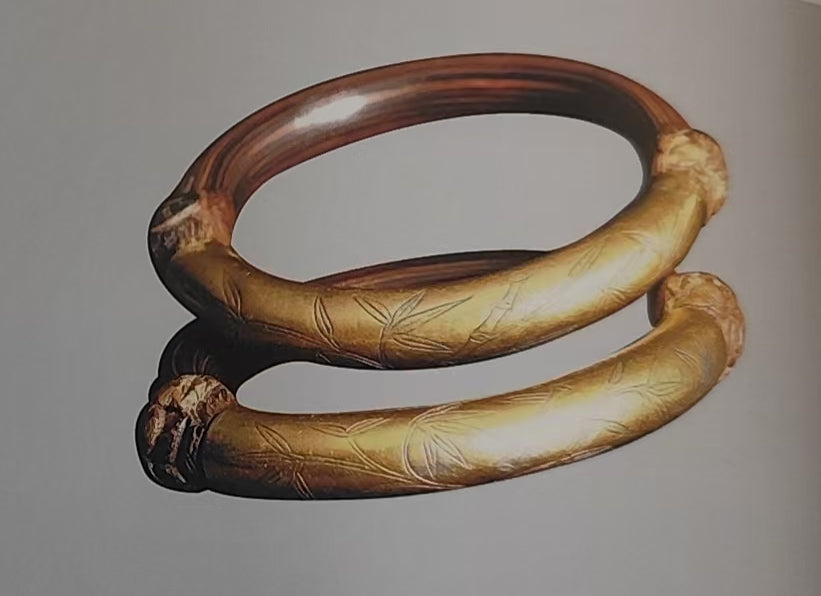
Silver-mounted vine bangles combine a hoop of vine with one or more fitted pieces of silver. On this Republican-era Chinese pair, a chased leaf pattern runs across the curved silver mounts, and the dark, striped vine remains visible along the back of each hoop. Wang Jinhua catalogues the pair under Anhui in Traditional Chinese Jewelry: Bangles, Rings, and Earrings. The listed diameter is 6.5 cm, and each bangle weighs 24 g.
The cover photograph is a crop of the original illustration on page 40. Wang calls the material used for this type of hoop feng teng (风藤). The catalogue’s regional label and terminology give the pair a context. The workshop and exact botanical species remain unconfirmed.
What Is a Silver-Mounted Vine Bangle?
Look at the pair from the front and then follow the curve to the back. The silver covers a substantial section facing the viewer. Behind it, the exposed brown vine carries long, close-set streaks that bend with the hoop. From the side, the changes in color and surface near both ends of the mount make it easier to see where the materials meet.
The mounts appear warm gold in the printed photograph, especially where light falls across the center. The catalogue identifies them as silver. Fineness and surface treatment would need examination of the objects. Their size is also recorded simply as a diameter, with the measuring points unspecified.
How Chased Silver Follows the Curve
Chasing uses a small hammer and differently shaped tools to work lines, dots, and textures into the surface of metal. A fine tool can trace the outline of a leaf. Other tools give a background enough texture to catch light differently from its surroundings. The Palace Museum describes chasing as a traditional way to create layers of decoration on metal.
On the pair, slender stems run along the length of the mounts. Pointed leaves open from the stems in small groups with space between them. They resemble bamboo leaves, although the catalogue does not identify the plant motif. In the photograph, the brightest reflection briefly obscures some lines. The leaf tips look sharper toward the edges of the curve. Related floral ornament on Qing silver bangles shows another way to pace plant forms across a narrow surface.

The Ethnic Costume Museum of Beijing Institute of Fashion Technology documents one approach on a comparable piece. A silversmith decorates a cut sheet, joins it into a tube, and forms a curve to fit the hoop. The vine is warmed and bent into a ring before it is secured to the silver. The account explains why the outer face and inner curve of a mount matter. The attachment method of the Anhui pair remains to be examined.
One Silver Section or Several
Wang distinguishes closed and open vine bangles in the same chapter. In the examples described, a closed form uses one section of silver and an open form uses two, with further sections sometimes added. The term “section” refers to a discrete mount on the hoop. One long mount gives a stem room to travel along the arc. Several smaller mounts can carry individual motifs spaced around the ring.
The pictured pair presents a continuous circle with a prominent silver section on each front. The lines of the chased stems and the exposed vine run in much the same direction. That shared orientation helps the two surfaces read as parts of a single hoop.
Qing and Republican-Era Vine Bangles Compared
Wang describes silver-mounted vine bangles as especially popular during the Republican period. Qing examples show that the use of metal mounts on vine predates that fashion. A Qing butterfly-pattern bangle in the Kaohsiung Museum of History has two silver mounts. The museum records a riveted cover at the join and a shop mark, Hengmao, on the inside. The silver is worked with butterflies, flowers, a sword, and a fan.
A different Qing bangle in the National Palace Museum, Taipei, joins the ends of a knotted vine branch with an openwork gold mount. Its design includes a qin and other musical imagery. The knots are left visible, making the shape of the branch an integral part of the piece.
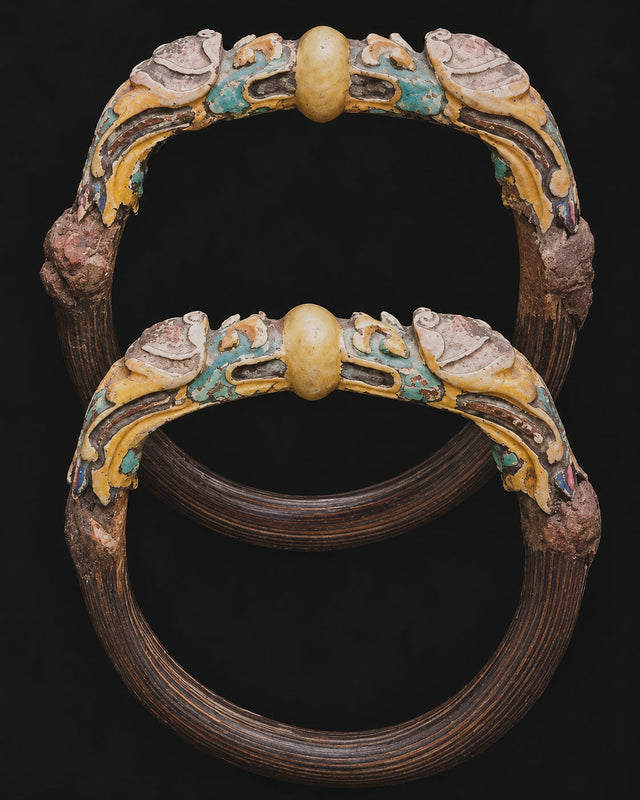
On page 36 of the same book, a pair of Qing dynasty silver-mounted vine bangles uses colored enamel and a double-dragon-and-pearl motif. The Republican pair on page 40 has much finer leaf lines across broader areas of exposed metal. The two pairs show what can be done with the same basic combination of a vine hoop and a metal mount.
Looking at the Bangles as a Pair
Placed together, the hoops are close in shape and their silver mounts face in the same direction. The natural grain still differs from one hoop to the other. The upper bangle gives a clearer view of the exposed rear arc. The lower one draws attention to the leaf shapes across the front mount. Take a moment at the points where silver meets vine. There the two curved surfaces show how much of the design depends on the fit.
Frequently Asked Questions
What does the Chinese name for this pair mean?
錾花银包藤手镯 means a vine bangle fitted with chased silver. 錾花 refers to the decoration worked into the surface of the metal.
Is 6.5 cm the inside diameter of the bangles?
The catalogue lists a diameter of 6.5 cm without specifying where it was measured. The inside diameter would have to be measured separately for a fit comparison.
Why do the silver mounts look gold in the photograph?
The printed photograph shows a warm yellow tone. The catalogue describes the mounts as silver. Gilding, alloy, and other surface treatment would need examination of the objects.
Were silver-mounted vine bangles made in the Qing dynasty?
Yes. Qing examples survive, including the butterfly-pattern silver-mounted vine bangle in the Kaohsiung Museum of History. Wang describes the style as particularly popular in the Republican period.
Related Botanical Silver Bracelets
These modern silver bracelets carry bamboo, foliage, and flowering-branch motifs.
-

Fine Silver Bamboo and Leaf Bracelet
A small green leaf charm accents a bamboo-shaped band in 999 fine silver.
-

Tang Grass Scroll Silver Bangle
Carved foliage scrolls run along a sterling silver bangle set with red agate accents.
-

Fine Silver Magpie and Plum Blossom Bracelet
A magpie and plum blossoms perch on the branch-shaped band in 999 fine silver.
References and Further Reading
- Wang Jinhua, Traditional Chinese Jewelry: Bangles, Rings, and Earrings. China Textile & Apparel Press, 2014, pp. 36 and 40. ISBN 9787518003389.
- The Palace Museum, Beijing, Zanhua (Chasing), glossary of decorative techniques.
- Ethnic Costume Museum of Beijing Institute of Fashion Technology, Vine Bangle with Chased Silver Mount. Collection record, diameter 7.5 cm.
- Kaohsiung Museum of History, Silver-Mounted Vine Bangle with Butterfly Motifs. Qing dynasty, KH2001.037.0032.
- National Palace Museum, Taipei, Vine Bangle with Gold Mount. Qing dynasty, 故雜008654N000000000.
Stories, symbols and everyday objects
Our journal explores Chinese culture and design. Traditions and interpretations vary by region and source. For a purchase, use the specifications on the individual product page.
About Chinese ShowcaseQuestions or corrections? Contact us ↗