The Chinese Showcase journal Schmuckwissen
Qing Dynasty Silver Bangles and the Meaning of Yipin Furen
A pair of Qing dynasty silver bangles from Henan carries the title Yipin Furen across four panels. Lotus and peony motifs pair a wish for prosperity with a reminder to act with integrity.
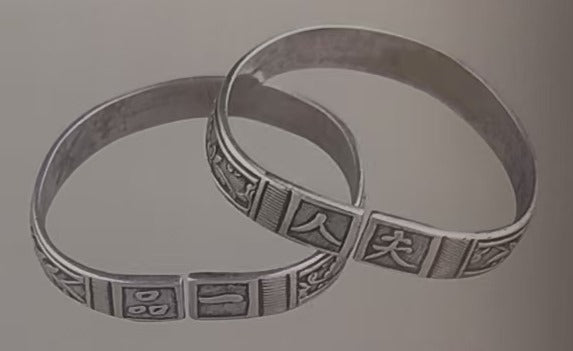
A pair of Qing dynasty silver bangles from Henan bears the inscription Yipin Furen, meaning “Lady of the First Rank.” The four characters are 一品夫人. Each bangle carries half the title. Peonies and lotus flowers curve around the bands, bringing two ideas together in silver. The peony evokes prosperity and honor. The lotus invites a second reading of the words for “first rank,” one that has to do with integrity. [1]
The silver bangles at a glance
| Date | Mid-Qing dynasty |
|---|---|
| Region | Henan, China |
| Material and form | Silver open bangles, made as a pair |
| Size and weight | 7 cm in diameter and 46 g per bangle, according to the catalogue |
| Inscription and decoration | Yipin Furen, peonies and lotus flowers |
How to read the inscription on the bangles
Start at the opening of each cuff. The ends of one bangle carry yī and pǐn, the characters for “first rank.” The other carries fū and rén, which together mean “lady” in this title. In the close-up, read each row from right to left, beginning with the upper row. Bringing the two cuffs together completes the inscription.

One horizontal stroke fills the panel for yī, and the three small shapes that make up pǐn fit inside a frame of much the same size. Short diagonal marks separate the lettering from the floral ornament. The lettering catches the light against a dark, dotted ground, the same contrast that makes the petals and leaves stand out farther along the bands.
What did Yipin Furen mean in the Qing dynasty?
Yipin Furen was a title the Qing court could confer on eligible women in the families of first-rank officials. It could honor a wife or a mother and was tied to the official’s rank. The award recognized the woman’s place in the family and could credit her work in bringing up children or managing the household.
An imperial document in the Beijing Art Museum’s collection illustrates how the title was used. It grants the mother of the Qing official Songyun the title of Lady of the First Rank after her death. The court used different wording for conferring an honor on a living person and for granting it posthumously. The catalogue identifies the bangles by the four characters they carry, while the original wearer’s identity remains unknown. [2]
What do the lotus and peony symbolize?
The peony stands for wealth and honor, while the lotus can suggest purity and integrity. The Song dynasty writer Zhou Dunyi set the two flowers side by side in his essay On the Love of the Lotus. He associated the peony with wealth and high standing and likened the lotus to a person of good character. What impressed him was how the lotus rose from mud and flowered cleanly above the water. [3]

The maker adapted the flowers to the narrow silver surface. The peony’s broad petals nearly fill the band, and its stems sweep out horizontally to follow the curve of the cuff. The lotus design leaves more room between the leaves and stems, so the fine dots in the ground remain visible. As the wrist turns, a leaf tip comes into view where a moment before there was only the edge of a flower.
The lotus and the wish for integrity in high office
In Mandarin, lián, meaning lotus, sounds like lián, meaning incorruptible. The words for a green lotus, qīnglián, sound like the word for upright and honest conduct. The catalogue reads the lotus beside yīpǐn as a reference to yīpǐn qīnglián (一品清廉), a wish for integrity in a person of high rank. The image supplies the second half of that phrase. [1]
A Ming dynasty Xuande porcelain dish in the Jinan Museum makes a useful comparison. The museum interprets the bundle of lotus at its center as a wish for integrity in office. Peony and lotus scrolls also appear around the dish. Its wide center shows the entire bouquet at a glance. On the silver bangles, the meaning emerges as the eye moves around the wrist, from the title at the openings to the flowers along the bands. [4]
Seen together, the peony and lotus express two wishes that can sit comfortably side by side. May the family prosper, and may it deserve the good name that comes with its standing.
Floral silver bangles to explore
Peony blossoms, lotus seedpods and other flowers still appear on Chinese silver bangles. These contemporary pieces use enamel or carved jade to bring color to the floral designs.

Pink Peony Fine Silver Enamel Bangle
Pink enamel petals and green leaves follow the curve of this 999.9 fine silver open cuff.

Hetian Jade Lotus Seedpod Silver Bangle
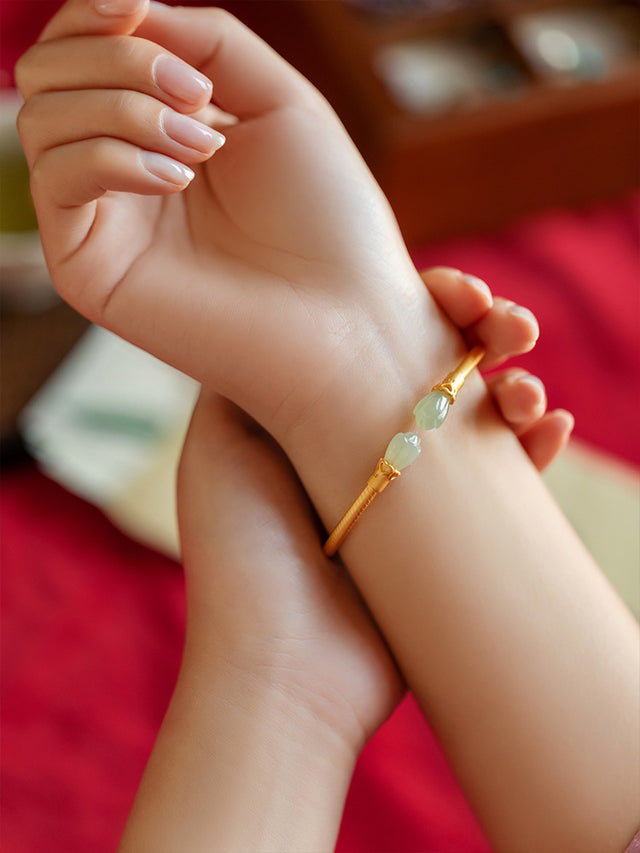
A carved green Hetian jade seedpod brings the lotus motif to an adjustable 925 sterling silver bangle.

Begonia Fine Silver Enamel Bangle
Begonia blossoms are picked out in enamel and gold-colored outlines on this 999 fine silver cuff.
Frequently asked questions
What does Yipin Furen mean in English?
Yipin Furen means “Lady of the First Rank.” In the Qing dynasty it was an honorific the court conferred on eligible women in high officials’ families, including wives and mothers.
How do you read the inscription on the two bangles?
In the close-up, read the upper row from right to left for yīpǐn (first rank), then the lower row from right to left for fūrén (lady). Each bangle carries two of the four characters.
What does a peony symbolize in Chinese jewelry?
The peony traditionally suggests wealth, honor and prosperity. Here, its full petals and spreading leaves sit alongside a title associated with high rank.
Why can a lotus stand for integrity?
The lotus became a symbol of moral purity because it flowers above muddy water. In Mandarin, lián (lotus) and lián (incorruptible) sound alike. Next to the words for “first rank,” the lotus evokes yīpǐn qīnglián, a wish for integrity in high office.
Who wore these Qing dynasty silver bangles?
The catalogue identifies the pair by its inscription and floral decoration. The identity of the original wearer is unknown.
References
- Illustrated catalogue entry for the mid-Qing pair of silver floral bangles inscribed Yipin Furen, Henan. The photographs are cropped from the supplied catalogue plates.
- Beijing Art Museum. Imperial document conferring honors on the parents of Songyun.
- Zhou Dunyi. On the Love of the Lotus, Song dynasty.
- Jinan Museum. Ming Xuande blue-and-white dish with a bundled lotus motif, featured in the museum’s exhibition on integrity in material culture.
Stories, symbols and everyday objects
Our journal explores Chinese culture and design. Traditions and interpretations vary by region and source. For a purchase, use the specifications on the individual product page.
About Chinese ShowcaseQuestions or corrections? Contact us ↗