The Chinese Showcase journal Chinesische Symbole
Opposing Cloud Scroll Pattern on a Chinese Bronze Belt Hook
Two curls turn in opposite directions across a Chinese belt-hook design. Follow the central sweep and see how it fits the small surface of a bronze fastening.
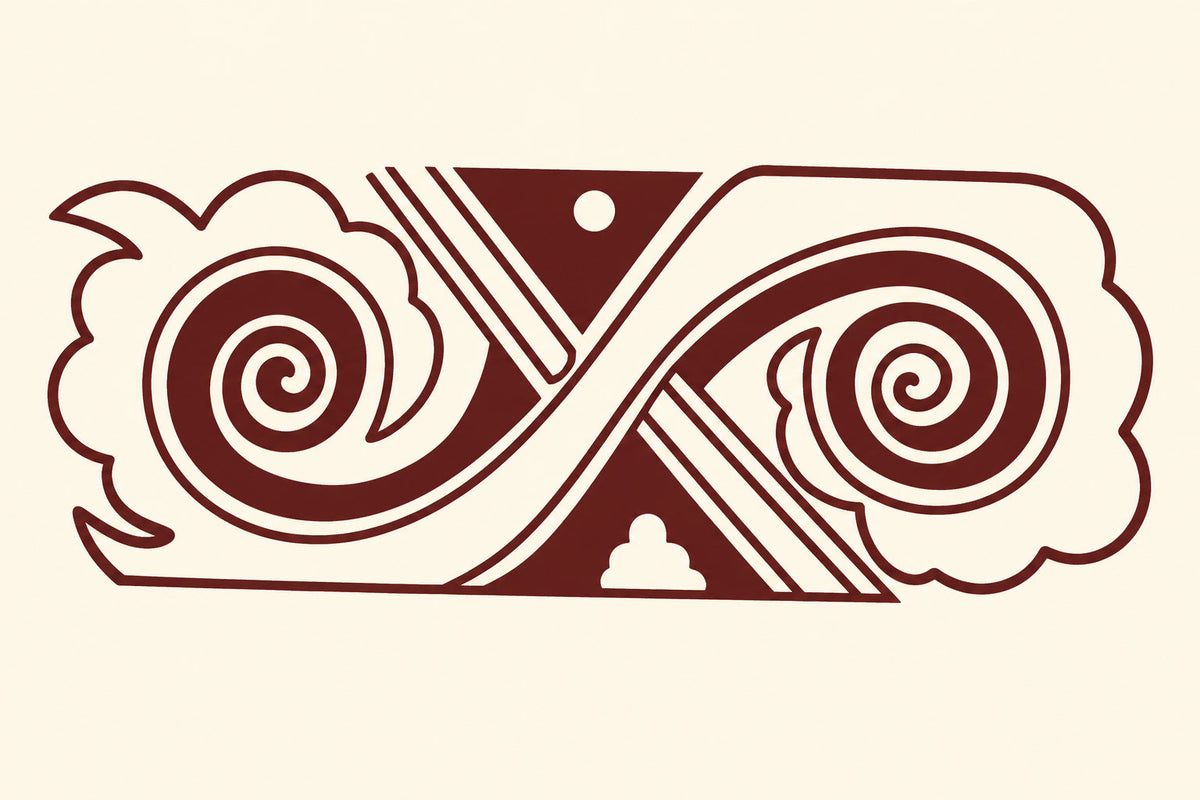
The opposing cloud scroll pattern, called zhèngfǎn juǎnyúnwén (正反卷云纹) in Chinese, brings two curls that face in opposite directions into one design. In handbook illustration 0006, a sweeping band connects the two ends and gives the motif a long, low shape. The caption identifies the object behind the design as a bronze belt hook with gold and silver inlay (金银错铜带钩). [1]

View the original photograph crop

How to Recognize Opposing Cloud Scrolls
Start with the two spiral centers. One sits toward the left end of the example, and the other sits higher toward the right. Each curl winds inward inside a rounded outer contour. The edges widen into softly scalloped lobes before narrowing back into the lines that run through the center. [1]
Follow the broad band as it sweeps from the lower left toward the upper right. Its changing curvature suggests an S. A set of fine, straight diagonal stripes crosses the central area on the opposite slant. Dark triangular fields above and below the crossing bring the curves into relief. One contains a small round mark, while another holds a small lobed form. These details help the eye distinguish the straight bands from the cloud curls. [1]
The two ends balance each other through their size, spacing and inward curl. Their outlines differ slightly, so the design retains the rhythm of a pair while giving each end a shape of its own.

Why the Pattern Fits a Chinese Belt Hook
A Chinese belt hook, or daigou (带钩), fastened the ends of a belt. The Seattle Art Museum's record for a bronze belt buckle hook explains that such hooks joined the ends of belts worn with ancient Chinese garments. Their visible surfaces could carry decoration as well as serve a practical function. [4]
In item 0006, the designer could use the length of the surface to draw the eye from one curl to the other. The center compresses into a narrow diagonal crossing, while the two rounded scrolls spread across the wider areas. At a glance the stretched outline reads as one ornament. Up close the two spirals and the smaller central marks become distinct. [1]
The caption identifies the object type and material, and the page groups the drawing with Warring States patterns. A record of the complete hook, including measurements, accession number and findspot, would help put the ornament in context. [1]
What Gold and Silver Inlay Adds to Bronze
The Chinese term jin yin cuo refers to decoration made by setting gold or silver into a prepared surface. The Palace Museum's entry for a late Warring States belt hook describes a bronze surface prepared with recessed designs. Metalworkers set thin strips or wires into the recesses, then polished the surface. The materials could catch the light differently along the same line. [2]
The Metropolitan Museum of Art holds a comparable Warring States belt hook, object 2002.134. The museum dates it to the fourth to third century BCE, lists its length as 20.3 centimeters, and records bronze inlaid with gold and silver as its medium. That record documents the technique on the same type of object. It serves as a comparison for the medium and scale. [3]
In the handbook drawing, dark and pale areas make each curl easy to follow. Those colors belong to the published illustration. Identifying which parts of the original were made with gold, silver or exposed bronze would require a documented photograph or examination of the object. [1]
How It Differs From Other Cloud Motifs
In the same handbook, item 0004 shows a cloud-and-thunder pattern in a row of compact, squared turns. The Palace Museum explains that cloud-and-thunder ornament can use rounded or square spirals. In item 0006, the turning lines are rounded and are organized as two large, oppositely oriented scrolls inside a single elongated composition. [1, 5]
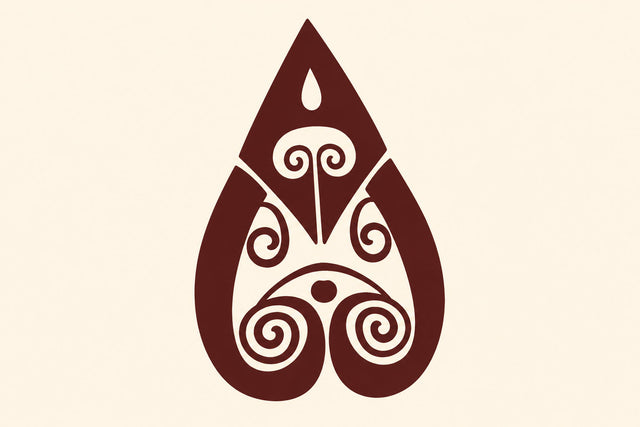
Item 0001, the vortex-shaped cloud scroll, places its curls around a central ring within a circular outline. Item 0007, the cloud-head scroll, fits its curls into a pointed outline with a lower pair of scrolls and smaller curls above. The quickest way to distinguish the three is to check how the curls relate to the overall outline. The motif in item 0006 runs lengthwise from one large curl to the other. [1]
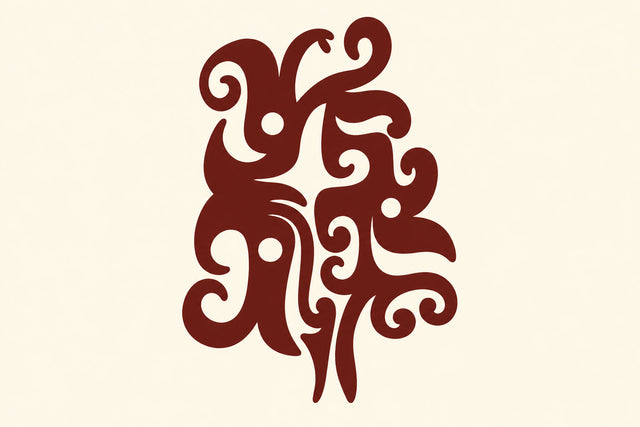
The variant cloud-and-thunder pattern in item 0005 offers another comparison. Its hooks gather into a compact upright form. [1]
What the Opposing Cloud Scroll Suggests
The spirals evoke movement because the eye keeps changing direction as it follows the lines. The pair also feels balanced because both ends carry a curl of comparable visual weight. Reading the arrangement as a play between motion and balance is an interpretation of the design we can see. The handbook caption identifies the motif and object type, so a more specific historical meaning remains open.
On a modern piece, a horizontal pendant, an elongated brooch or a short decorative band can show the same relationship clearly. The pattern stays legible when the two curled ends have room to turn and the diagonal passage between them remains easy to follow. On a smaller piece, the central marks can be simplified while the facing relationship of the scrolls still carries the design.
Frequently Asked Questions
What is an opposing cloud scroll pattern?
It is a Chinese decorative composition with two cloud scrolls that turn in opposite directions. In handbook illustration 0006, an S-like sweep links the two spiral ends along a horizontal axis.
What is the Chinese name for the opposing cloud scroll pattern?
The handbook calls it 正反卷云纹, or zhengfan juanyun wen. The name describes the opposite orientation of the curling cloud forms.
What was the pattern on in the handbook?
The handbook identifies a bronze belt hook with gold and silver inlay. Entry 0006 appears in the Warring States section as an illustration of the motif.
Are opposing cloud scrolls and yun lei wen the same design?
Both involve turning lines. Yun lei wen is a broader cloud-and-thunder pattern category often seen as a geometric repeat. The illustrated opposing cloud scroll pairs two rounded curls in one lengthwise composition.
Does the image show the original inlay colors?
It shows the handbook's dark and pale drawing. The caption records gold and silver inlay, while the placement and appearance of the individual metals would need to be verified from the original object.
Jewelry with Cloud and Scroll Motifs
These contemporary pieces use details such as curling lines, shaped cloud heads or openwork.


References
- Hongtang Meixue. Pattern Design Quick Reference Handbook (纹样设计速查手册). Posts & Telecom Press, 2024. ISBN 9787115643353. Cloud Patterns, Warring States section, illustration 0006.
- The Palace Museum, Beijing. Silver-inlaid chi-headed belt hook (错银螭首带钩). Late Warring States period. Collection entry and glossary for belt hooks and metal inlay.
- The Metropolitan Museum of Art. Belt hook, bronze inlaid with gold and silver, China, fourth to third century BCE, object 2002.134. Comparative object.
- Seattle Art Museum. Bronze Belt Buckle Hook, object 49.98. Collection entry on the use of belt hooks.
- The Palace Museum, Beijing. Cloud-and-thunder pattern (云雷纹). Glossary entry.
Stories, symbols and everyday objects
Our journal explores Chinese culture and design. Traditions and interpretations vary by region and source. For a purchase, use the specifications on the individual product page.
About Chinese ShowcaseQuestions or corrections? Contact us ↗