The Chinese Showcase journal Chinesische Symbole
The Diamond-Shaped Spiral Cloud Scroll in Chinese Lacquerware
A diamond-shaped spiral cloud scroll frames four central spirals with a long, pointed outline. Explore how to identify the pattern and compare it with cloud scrolls on Chinese lacquerware.
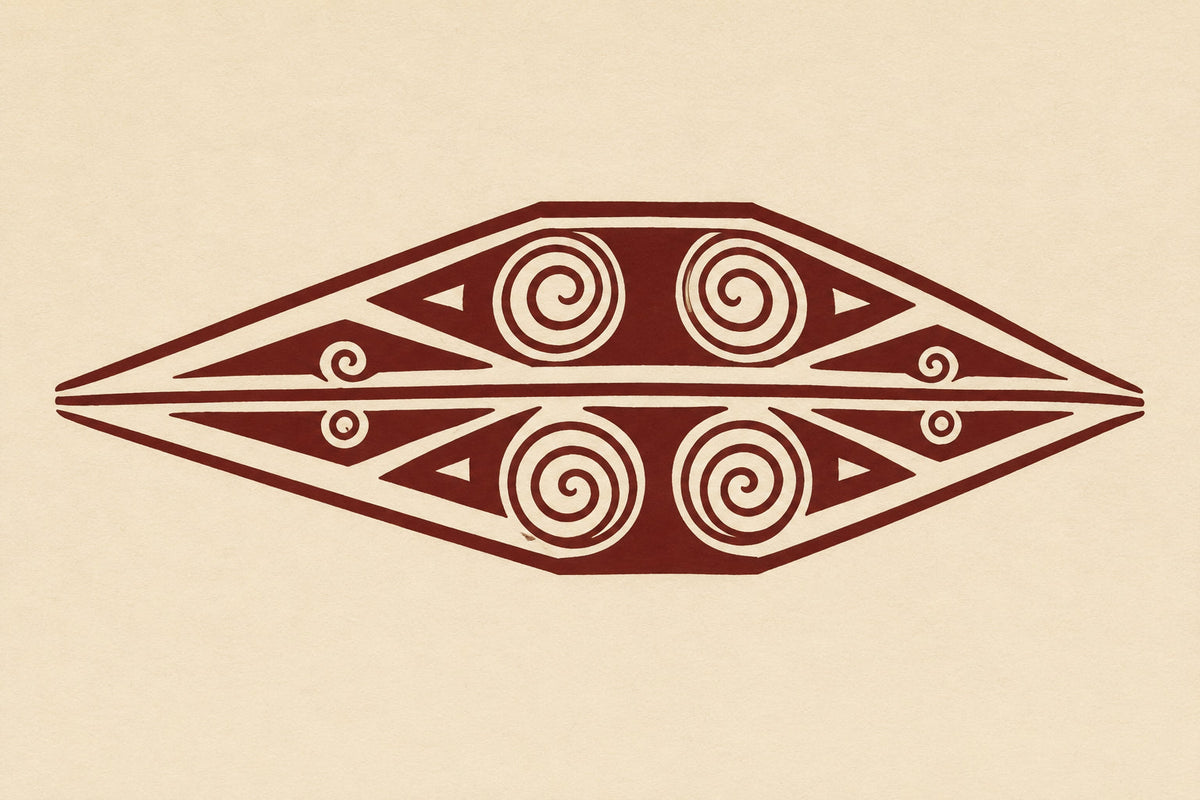
A diamond-shaped spiral cloud scroll is a decorative motif with four prominent spirals inside a long, pointed frame. In the lacquerware design shown here, two spirals sit above a narrow horizontal band and two below it. Smaller curls and triangular gaps lead toward the tips. The same curling shape appears at different scales, giving the pattern a sense of movement within a balanced outline.
The design appears as item 0003 in Hongtang Meixue’s Pattern Design Quick Reference Handbook, where it is identified as a lacquerware motif. The original object, its date, its findspot, and the placement of the pattern on the vessel remain to be confirmed.

View the original photograph crop

How to Identify the Diamond-Shaped Spiral Cloud Scroll
Start with the outline. It comes to a point on the left and right, with short, flatter edges above and below the center. The broader middle makes room for four large spirals. Parallel lines just inside the outline draw closer together as they approach the tips.
A narrow, pale band divides the dark field into upper and lower halves. The four large spirals form two rows of two, with enough room between them for each to remain distinct. Follow one from its outer edge toward the center and the arc tightens. The horizontal band keeps drawing the eye across the design, while the spirals invite a closer look at the middle.
Near the big spirals are small triangular gaps. Farther out, smaller curls fit into the space left by the tapering outline. Step back and the triangles recede, leaving the four main spirals easy to pick out. Look closer and the smaller curls draw attention back toward the tips.
What Makes It a Repeating Cloud-Scroll Pattern?
Each part of the name points to a different feature. Diamond-shaped describes the outline, spiral describes the curling lines, and cloud scroll is the handbook’s classification. The sense of repetition comes from the large curls answering one another across the center line and the same curling motion returning at a smaller scale toward the ends.
The elongated shape also lends itself to a border. Place several units tip to tip and they form a tight band. Leave a short interval and each outline becomes easier to read. The photograph shows one design unit. An image of the complete object would help establish whether the design originally repeated along an edge or around a rim. In the related vortex-shaped cloud-scroll pattern, the arrangement of curves around a center offers another way to organize the same sense of rotation.
How Cloud Scrolls Work on Lacquerware
A handbook presents the design on a flat page. On a vessel, the surface changes what the pattern can do. A narrow rim can carry a band of repeated shapes. A broad interior can hold a central design. The sloped wall of a bowl or dish favors details that can be read across a curved surface. From the side, the rim usually catches the eye first. Looking down brings the center into view.
The Warring States Painted Lacquer Dish with Cloud Scrolls in the Yangzhou Museum shows how much can change from one part of a vessel to another. Its rim carries diamonds, zigzags, and waves. The inner wall pairs angular forms with cloud scrolls and dots. At the bottom, rolled forms appear alongside stylized bird heads. Each surface has a different arrangement, even though several shapes recur across the dish.
The Palace Museum’s Western Han Painted Lacquer Dish with Cloud Dragons, excavated from Tomb 28 at Gaotai in Jiangling, Hubei, uses another arrangement. Its connected curls occupy the center, where the museum interprets them as stylized cloud dragons. Diamonds appear in an outer band. In item 0003, curls sit inside the diamond-shaped frame. On the Western Han dish, the same visual elements help distinguish the center from the border.
The contrast between light lines and dark fields in the reference image makes the rhythm easy to see. The dark areas gather in the broad middle and narrow toward the tips. In the source photograph, the printed illustration has a reddish-brown tone. The original lacquer colors remain to be confirmed.
What Do the Four Spirals Mean?
The curls can suggest drifting clouds or the swirl of water. Each spiral produces a sense of movement. Grouped around a shared axis and framed by a pointed outline, the four spirals give the design a steady center. For a modern viewer, the repeated curls can suggest continuity, while the paired arrangement conveys balance.
Reading the four spirals as the four seasons or the four directions would require evidence from the period or a documented use of the motif. The clearest clue offered by the image is compositional. The four large curls make full use of the central space, and the smaller ones carry that movement toward the edges.
How It Differs from Thunder Patterns and Phoenix Cloud Scrolls
The Palace Museum’s glossary describes a typical thunder pattern as a squared spiral formed by angular turns. Here the sharp angles belong chiefly to the outer frame, while the main spirals use rounded arcs. To tell the designs apart, look at both the shape of the outline and the way the main line turns.
The handbook’s preceding example offers another comparison. Item 0002, the phoenix and cloud scroll motif in Chu lacquerware, has two recognizable bird heads, with curves extending into the birds’ bodies. In item 0003, the long axis and the two rows of spirals guide the eye. Both designs use curling lines, and each gives the viewer a different way to follow them.
Adapting the Motif Today
The long shape can work on a bookmark or repeat along woven trim or the edge of a box lid. On a small piece of metalwork, widening the gaps or simplifying the tiny curls at the tips helps keep the main pattern legible. The elongated outline, horizontal axis, and four large spirals carry most of the design.
To sketch it, begin with the axis and outer shape, then place the four main spirals before drawing the smaller curls. The process shows how closely the pattern follows the space available. In the broad middle, the line has room to turn fully. At each narrow end, a shorter curve brings the motion to a close.
Frequently Asked Questions
How do you identify a diamond-shaped spiral cloud scroll?
Look for a long, pointed outline, four large spirals in two rows, and smaller curls near the tips. A narrow band divides the upper and lower halves.
Was this cloud scroll painted as a repeating border?
Its pointed outline makes it suitable as a repeat unit in a border. The handbook shows a single unit, so the arrangement on the original object remains unknown.
Do the four spirals stand for the four seasons?
The four spirals balance the design around its center line. The reference handbook gives no account of what their number meant historically.
Which period is the original lacquerware from?
The date of item 0003 remains unconfirmed. The handbook identifies the design as lacquerware. The Warring States and Western Han dishes discussed in this article are independently dated examples.
Jewelry with Cloud Scroll Motifs
-

Openwork Cloud Drop Earrings
Four cloud curls form a diamond-shaped cluster above each gold-tone drop.
-

Auspicious Cloud Silver Ring
Interlocking cloud curls fill the openwork face of this sterling silver ring.
-

Blue Enamel Cloud Bangle
Blue enamel cloud scrolls repeat along an adjustable open bangle.
Stories, symbols and everyday objects
Our journal explores Chinese culture and design. Traditions and interpretations vary by region and source. For a purchase, use the specifications on the individual product page.
About Chinese ShowcaseQuestions or corrections? Contact us ↗